
How to Calm Anxiety Quickly: What Actually Helps in the First Few Minutes

Sometimes anxiety rises so quickly that it can feel as if everything narrows at once.
Your chest feels tight. Your thoughts speed up. You become very aware of your breathing, your heartbeat, or the uneasy sense that something is not right. In that moment, most people want the same thing: for the feeling to stop immediately.
That reaction is very understandable. Anxiety can feel intense, urgent, and deeply convincing.
But often, the first thing that helps is not trying to force the feeling away. It is helping the spiral not grow any further.
When anxiety starts to build, the mind can become alarmed by the anxiety itself. The body reacts, the thoughts become more frightening, and a second layer of fear gets added on top. This is often the point where anxiety begins to escalate.
So in the first few minutes, the goal is usually not to become perfectly calm straight away. It is to bring a little steadiness to what is happening, reduce the extra fear being added, and help your mind stop treating the feeling as proof that something terrible is happening.
In therapy, this is often one of the most important shifts: responding to anxiety as a stress alarm that needs steadying, rather than as an emergency that must be shut down immediately.
That small change in approach can make a real difference.
In this guide
In this article, you will learn:
What anxiety is doing in the moment
Why it can escalate so quickly
What many people misunderstand about calming down
What often helps in the first few minutes
One very small step you can try straight away
What this experience actually is
Anxiety is the mind and body preparing for possible danger.
That is why it can come with a fast heartbeat, tightness in the chest, shaky or shallow breathing, dizziness, racing thoughts, muscle tension, or the strong urge to do something immediately. These reactions are part of the body’s alarm system. They are uncomfortable, and sometimes frightening, but in everyday anxiety they are often signs of activation rather than signs that something is seriously wrong.
Many people I meet in practice say anxiety feels as though it came out of nowhere. But when the moment is slowed down, there is often a recognisable sequence.
Something catches the mind as potentially threatening. It may be a thought, a physical sensation, an email, a memory, a social moment, or simply uncertainty. The body responds. Then the mind tries to make sense of that response.
If the mind lands on an explanation such as I’m losing control, I won’t cope, this is getting worse, or something is wrong with me, the alarm usually intensifies.
So anxiety is not only about the original trigger. It is also about the meaning that gets added afterwards.
To understand the bigger picture behind anxious reactions, start with Understanding Anxiety: A Therapist’s Guide.
If anxiety shows up mainly through body sensations, Why Anxiety Feels Physical may help explain it.
If stress and overload are contributing to anxiety, see Understanding Stress and Mental Overload.
Psychoeducation: Why anxiety can escalate so fast
A useful way to understand anxiety is as a spiral.
Something triggers concern. A sensation or thought appears. The mind reads it as a sign that something is wrong. That interpretation creates more fear. The body becomes more activated. Then the stronger sensations seem to confirm the fear.
It can happen very quickly.
For example, you notice tightness in your chest. Then comes the thought: Why is this happening? Then: I need to calm down right now. The body becomes even more tense. The sensation feels stronger. And now the whole experience seems more alarming and more believable.
This is one reason anxiety can feel so overpowering. The sensations are real, but the meaning attached to them can make the experience gather speed.
A particularly important part of this is what therapists sometimes describe as anxiety about anxiety. In everyday language, this means the second layer of fear that sounds like:
I shouldn’t feel like this
I need this to stop
What if this gets worse?
If I feel like this, I won’t cope
Very often, this second layer is what turns anxiety from difficult into overwhelming.
What many people misunderstand
One of the most common misunderstandings is the idea that calming anxiety quickly means gaining complete control over every feeling immediately.
Usually, a more realistic and more helpful aim is to:
lower the intensity a little
slow the spiral
stop adding frightening meaning
make the next few minutes more manageable
That may sound modest, but it is often exactly what helps.
Breathing is another area that is often misunderstood. Many people have heard that breathing exercises should calm anxiety quickly, then feel worse because they start trying to do them perfectly. They monitor every breath, try to force themselves to settle, and feel even more alarmed when the anxiety does not disappear straight away.
Breathing tends to help most when it is approached gently. The aim is not to get it right in a perfect way. The aim is to help the body slow down enough that the mind stops reading every sensation as danger.
Grounding can be misunderstood in a similar way. It is not about pretending you are not anxious or trying to distract yourself so thoroughly that you feel nothing. It is about helping your attention return to the present moment, instead of staying locked onto threat.
Therapist perspective
In therapy, I often see that people become frightened not only by what triggered the anxiety, but by the anxiety itself.
They start checking their body closely. They monitor whether they are getting worse. They look for reassurance. They leave situations quickly. They wait until they feel completely calm before carrying on.
All of that makes sense. It is an understandable attempt to feel safer.
But it can unintentionally teach the mind a painful lesson: this feeling is dangerous, and I can only cope if I escape it, control it, or get reassurance first.
That lesson is part of what keeps anxiety sticky.
A turning point often begins when someone learns to respond in a different way. Not by pretending they feel fine, and not by demanding that the feeling disappear, but by relating to it more steadily and more accurately.
Something like:
This is anxiety. My body is sounding an alarm. This feels intense, but intensity is not the same as danger.
That kind of response reduces the struggle around the anxiety. And when the struggle reduces, anxiety often has less to feed on.
What actually helps in the first few minutes
When anxiety is rising, it can help to keep the response very simple.
1. Name what is happening
Try quietly putting words to the experience:
This is anxiety.
My body is activated.
This feels strong, but it is not proof of danger.
This can help interrupt the moment where every sensation starts to feel like evidence that something is seriously wrong.
2. Slow the breath gently
If it feels comfortable, try this:
Breathe in gently for 3 to 4 seconds.
Breathe out gently for 4 to 6 seconds.
There is no need to take a huge breath. In fact, it often helps more to think slower and softer, not bigger.
You might stay with this for one to three minutes.
This can be useful because anxiety often changes breathing without you realising it. A longer, gentler out-breath can help reduce some of the physical escalation.
3. Widen your attention
Anxiety tends to pull attention tightly onto the feeling of threat. So it often helps to gently widen your focus again.
You might:
name three things you can see
feel your feet on the floor
hold an object and notice its texture or temperature
listen to one sound in the room for a few seconds
The aim is not to force anxiety away. It is to help your system stop circling around danger signals quite so intensely.
A small strategy to try
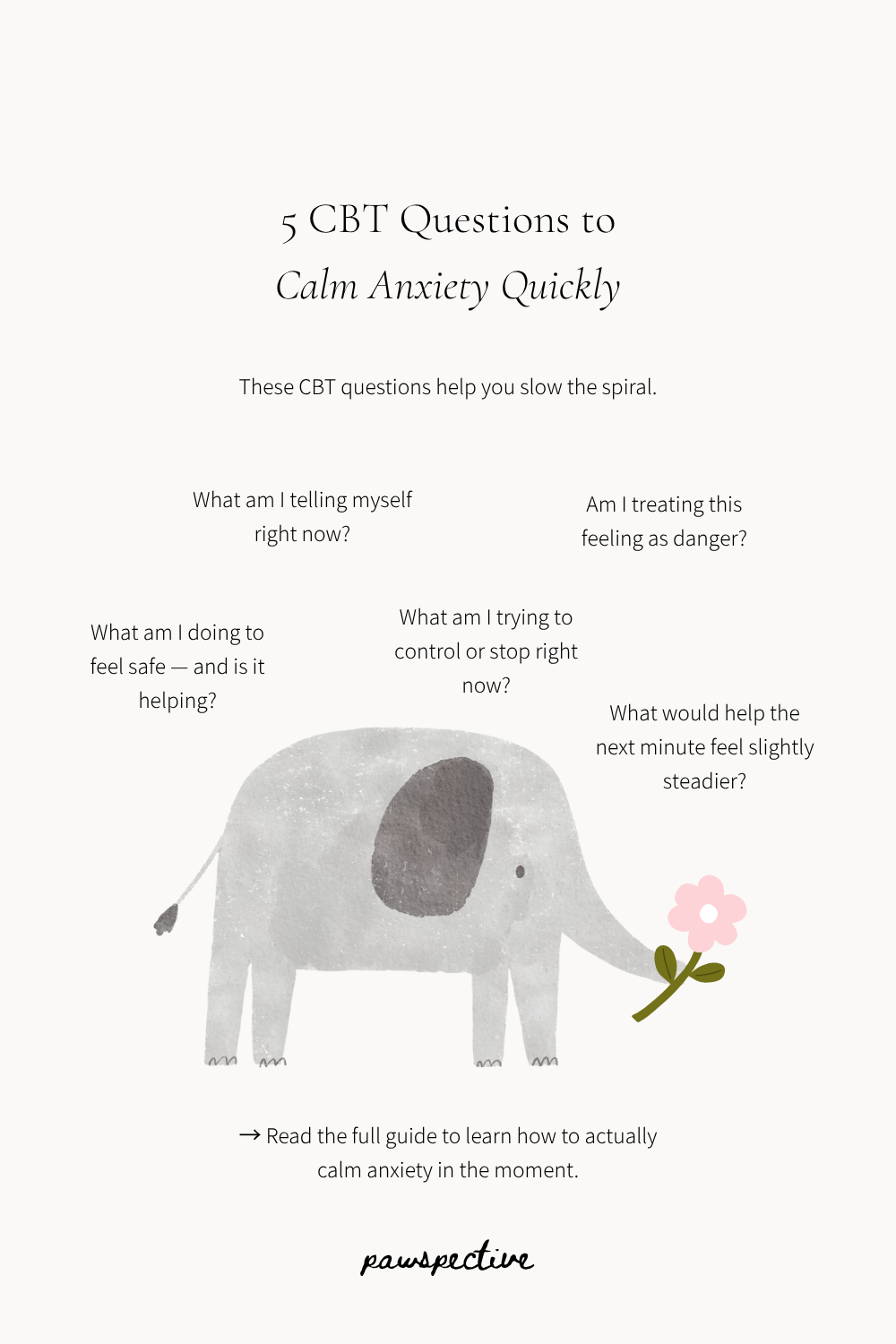
A useful question in an anxious moment is:
What am I doing right now to try to make myself feel safe?
You might be checking your body, monitoring your breathing, asking for reassurance, gripping tightly, scanning for signs that this is getting worse, or waiting until you feel calm enough before doing anything else.
Then ask yourself:
Can I soften one of those responses slightly?
Not all at once. Just a little.
Perhaps you stop checking your body for one minute. Perhaps you loosen your jaw. Perhaps you let one sensation be there without analysing it. Perhaps you stay where you are for thirty seconds longer before deciding what to do next.
This may seem small, but these moments matter. They begin to teach the mind something new: I can feel anxious and still cope.
A very small step you can try now
If you are feeling anxious as you read this, try this one sentence:
I do not need to solve all of this right now. I only need to help the next minute feel a little steadier.
Then let your shoulders drop if they can. Unclench your hands if you notice tension there. Feel where your feet are making contact with the floor.
Nothing dramatic. Just one small signal of steadiness.
Often that is enough to begin.
A guided structure can sometimes help
In my therapy room, I often see how quickly anxiety creates tension in the body. Shoulders lift. The jaw tightens. Hands clench. Breathing becomes shallow. Many people are so focused on the anxious thoughts that they do not fully notice how much the body is bracing at the same time.
One practice I return to often is what I think of as the release practice. I love this exercise because it is simple, gentle, and helps people respond to anxiety without fighting it. Rather than trying to force calm, you practise noticing where anxiety is creating tension and then releasing that tension step by step.
This can help because anxiety and physical bracing often strengthen each other. The more the body tenses, the more the mind reads that tension as a sign that something is wrong. When you slowly soften one area at a time — your hands, your jaw, your shoulders, your stomach — you are giving the body a different message. Not that everything feels perfect, but that it is safe enough to come down a notch.
You can explore it here:
Closing reflection
Anxiety often settles more easily when you stop fighting it as if it were an emergency.
That does not mean liking it. It does not mean doing nothing. It means responding in a way that reduces escalation rather than adding more fear.
A steadier breath. A more accurate thought. A wider focus. A little less struggle.
That is often what helps in the first few minutes.
Real change usually begins there: not with perfect calm, but with a different response repeated often enough that the mind and body begin to learn that anxiety is something you can move through, not only something you must fear.
You might also find helpful


Safety note
This article is intended for educational purposes and does not replace professional mental health care. If you are experiencing significant distress or mental health difficulties, seeking support from a qualified professional can be an important step.
Sources & Further Reading
Barlow, D. H. (2002). Anxiety and its disorders: The nature and treatment of anxiety and panic (2nd ed.). Guilford Press.
Beck, A. T., Emery, G., & Greenberg, R. L. (1985). Anxiety disorders and phobias: A cognitive perspective. Basic Books.
Clark, D. A., & Beck, A. T. (2010). Cognitive therapy of anxiety disorders: Science and practice. Guilford Press. Clark, D. M. (1986). A cognitive approach to panic. Behaviour Research and Therapy, 24(4), 461–470. Craske, M. G., Treanor, M.,
Conway, C. C., Zbozinek, T., & Vervliet, B. (2014). Maximizing exposure therapy: An inhibitory learning approach. Behaviour Research and Therapy, 58, 10–23. https://doi.org/10.1016/j.brat.2014.04.006 Hofmann, S. G., Asnaani, A.,
Vonk, I. J. J., Sawyer, A. T., & Fang, A. (2012). The efficacy of cognitive behavioral therapy: A review of meta-analyses. Cognitive Therapy and Research, 36, 427–440. https://doi.org/10.1007/s10608-012-9476-1 Meuret, A. E., Wilhelm, F. H.,
Ritz, T., & Roth, W. T. (2008). Breathing training for treating panic disorder: Useful intervention or impediment? Behavior Modification, 32(3), 296–321. https://doi.org/10.1177/0145445507309022
Öst, L.-G. (1987). Applied relaxation: Description of a coping technique and review of controlled studies. Behaviour Research and Therapy, 25(5), 397–409. https://doi.org/10.1016/0005-7967(87)90017-9
