
Why Emotions Sometimes Feel Overwhelming

There are moments when a feeling seems to arrive all at once.
You might be holding it together through the day, then suddenly feel tearful in the kitchen, snappy with someone you love, or completely flooded after one small comment, one email, or one change of plan. At other times, it is less visible from the outside but just as intense on the inside: your mind feels noisy, your chest feels tight, and it becomes strangely hard to think clearly or know what you need.
Many people assume this means they are too sensitive, too emotional, or not coping well enough. In reality, overwhelming emotion is usually far more understandable than that. Often, it is not that a feeling is simply “too big”. It is that emotional intensity, mental attention, interpretation, and the effort of trying to manage it all pile up at the same time.
In this article, we will look at why emotions can feel so overpowering, what many people misunderstand about overwhelm, and one small way to respond more gently and effectively when it happens.
In this guide
In this article, you will learn:
Why emotions can feel intense and difficult to manage
How the mind can unintentionally amplify feelings
What psychology says about emotional overwhelm
A simple therapist-informed strategy to regain clarity

What this experience actually is
Most people know the experience of saying, “I do not even know why I am reacting like this.”
Perhaps you feel disproportionately upset by something small. Perhaps you are not reacting outwardly at all, but inside it feels as though the emotion is taking up too much space. You cannot settle. You cannot get perspective. You keep replaying what happened or criticising yourself for not coping better.
In therapy, I often see that people are not overwhelmed simply by the original feeling itself. More often, they are overwhelmed by the combination of the feeling and everything that follows it. A moment of hurt becomes analysis. Anxiety becomes prediction. Sadness becomes self-judgement. Frustration becomes pressure to calm down immediately.
That pattern is psychologically understandable.
Emotions are designed to capture attention. They are part of the mind and body’s way of responding to what feels significant. So when something matters, your emotional system does what it is built to do: it gets your attention, shifts your body into readiness, and prioritises the situation. That does not mean the emotion is dangerous. It means your system has registered something important.
The difficulty is that this often happens at the very moment when your capacity is already reduced. If you are tired, stressed, uncertain, overstimulated, or already carrying a lot internally, even an ordinary feeling can become harder to process. The issue is often not weakness. It is high emotional load combined with low regulation capacity in that moment.
To understand the bigger emotional pattern, see Emotional Regulation: Why Emotions Come in Waves.
If overwhelm quickly turns into inner criticism, Why Am I So Hard on Myself? Understanding the Psychology of Self-Criticism may also resonate.
If stress is making everything feel harder to manage, read Understanding Stress and Mental Overload.
Psychoeducation: How emotions are processed over time
A helpful way to understand this comes from emotion regulation research. Emotion regulation means the processes through which people influence which emotions they have, when they have them, and how they experience or express them.
That may sound technical, but the everyday meaning is quite simple: emotions do not only affect us; we are also constantly responding to them.
This matters because overwhelm can develop at several points.
Sometimes it begins before an emotion fully gathers force. For example, you may already be tense, depleted, or on edge, which makes you more vulnerable to feeling emotionally flooded.
Sometimes it happens during the emotional moment. The feeling rises quickly, your attention narrows, your body activates, and your mind starts scanning for meaning or danger.
And sometimes it grows afterwards, when the mind keeps replaying, suppressing, analysing, or fighting what you felt.
This is one reason two people can have similar emotional triggers but very different experiences of overwhelm. It is not only about what they feel. It is also about how the emotion is processed, labelled, and responded to.
Emotional intensity is not the same as emotional danger
Another important point is that emotional intensity is not the same as emotional danger. A strong emotion can feel disruptive, uncomfortable, and consuming without meaning you are losing control or that something terrible is happening. The emotional system is action-oriented. It is meant to make important things feel important.
How our responses can amplify emotions
Research also suggests that some ways of coping tend to intensify distress when used rigidly. Rumination means repeatedly going over the feeling or situation without moving towards clarity or action. Suppression means trying to push feelings down or hide them. Experiential avoidance means trying urgently to get away from inner discomfort. These responses are understandable, but they often make the experience heavier.
Many people I meet in practice describe a feeling as if it “came out of nowhere”. But when we slow the moment down together, the pattern is often clearer. The first feeling may have been manageable. What made it overwhelming was everything added on top: overthinking, resisting, judging, and trying desperately to make it stop.
Why naming emotions can reduce overwhelm
There is also growing evidence that naming emotions more precisely can help. When everything is described only as “overwhelming”, the experience often stays vague and flooded. When someone can say, “This is disappointment”, “This is pressure and frustration”, or “This is anxiety mixed with shame”, the mind often becomes more flexible. The feeling may still be painful, but it is no longer one large, undefined wave.
What many people misunderstand
A common misunderstanding is that overwhelming emotion means someone is bad at coping.
That is usually too simple, and often unfair.
Being overwhelmed is often better understood as a state, not a character flaw. Sleep deprivation, chronic stress, uncertainty, cognitive overload, grief, ongoing self-criticism, or feeling emotionally alone can all reduce the mind’s flexibility. In those moments, even ordinary emotions can feel much harder to manage.
So if you become overwhelmed, it does not automatically mean you are too sensitive or doing something wrong. More often, it means your system is carrying a lot and does not currently have enough space, energy, or structure to process it smoothly.
Therapist perspective
One pattern I see regularly is that people fear they are losing control, even when they still look functional from the outside.
They may still be working, replying, parenting, talking, and doing what needs to be done. But internally, the emotion is taking up so much mental space that they feel far from themselves. They cannot think clearly. Their attention narrows. Perspective becomes hard to access. Choice feels smaller.
That internal experience can be frightening. It can also lead people to become even more alarmed by the emotion itself.
In my work with clients, a gentle shift often begins when they stop treating the emotion as proof that something is wrong with them and start seeing it as a sign that their system needs a more workable response. That change is subtle, but important. It moves the person out of self-attack and towards understanding.
A small strategy to try: notice, name, and narrow it down
When emotion feels flooded, a very small intervention is often more helpful than a complicated one.
A practice I often teach is this: notice, name, and narrow it down.
Use it when you feel tearful, irritable, mentally noisy, shut down, or emotionally flooded.
Start with a pause and say to yourself: “Something is happening in me right now.”
Then replace broad language such as “I’m overwhelmed” with a more specific label. Try: “I think this is disappointment.” Or: “This feels like pressure and frustration.” Or: “There is anxiety here.”
After that, add one sentence of allowance: “I do not need to get rid of this immediately.”
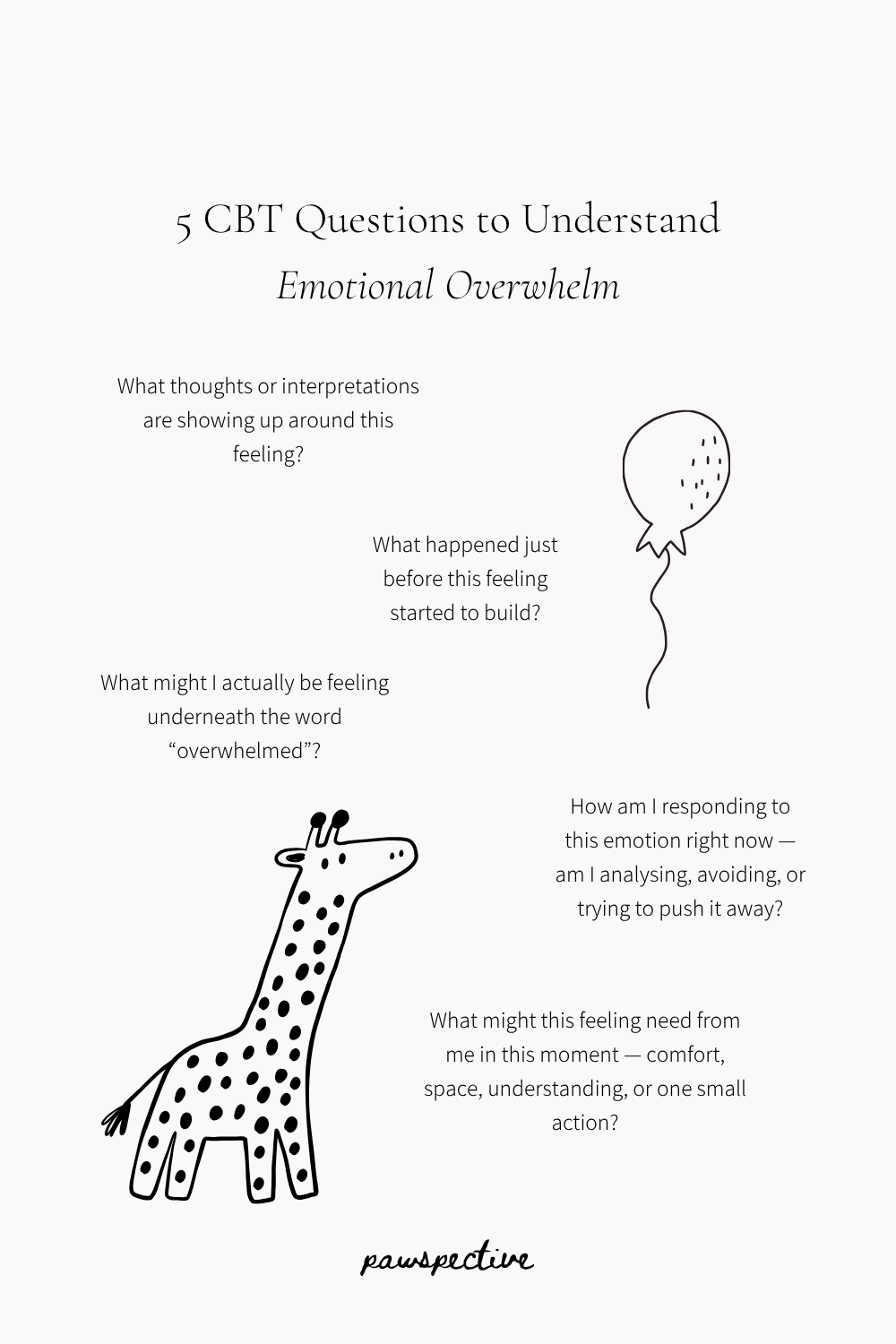
Then ask one gentle question: “What does this feeling need from me right now: comfort, space, perspective, or one practical action?”
Why can this help?
Because it reduces emotional flooding. It also interrupts the secondary struggle that often makes emotions bigger. Instead of fighting the whole experience, you are creating a little more clarity and distance. You are moving from being fully inside the emotion to beginning to reflect on it.
A very small step you can try now
Pause for five seconds and finish the sentence: “Under the overwhelm, I might actually be feeling…”
Even if you are not fully sure, the act of trying to name it more precisely can soften the intensity.
A guided structure can sometimes help
In my work with clients, I often notice that these ideas make sense on an intellectual level, but can feel much harder to access in the middle of a strong emotional moment. When feelings are intense, the mind tends to narrow, and it becomes difficult to step back or remember what might actually help.
One approach I frequently use in sessions is a simple observing technique. Instead of getting pulled further into the feeling, we practise gently stepping back and noticing what is happening — almost as if you are watching the emotion rather than being fully inside it. This small shift can create just enough distance to respond more calmly and intentionally.
Because many people find it easier to practise this with guidance, I created a small structured kit that includes a short guided audio exercise, reflection prompts, and clear psychoeducation. It is designed to help you build this observing stance step by step, especially in moments when emotions feel close and overwhelming.
You can explore it here:

Closing reflection
Emotions can feel overwhelming when the system is highly activated and short on flexibility. That does not mean the emotion is too much, or that something has gone wrong within you. More often, it means your mind and body are trying to process something important at a time when your resources are already stretched.
In those moments, the goal is not to eliminate the feeling as quickly as possible. It is to respond to it in a way that creates a little more space, a little more clarity, and a little more steadiness.
Emotions tend to shift when they are understood, named, and allowed to move, rather than pushed away or analysed endlessly. This is not something that changes overnight. It is a gradual process of learning how to relate to your inner experience differently.
If overwhelm is something you recognise in yourself, it may help to approach it with curiosity rather than judgement. Instead of asking, “What is wrong with me?”, you might begin to ask, “What is happening in me right now, and what might I need?”
That small shift is often where change begins.
You might also find helpful



Safety note
This article is intended for educational purposes and does not replace professional mental health care. If you are experiencing significant distress or mental health difficulties, seeking support from a qualified professional can be an important step.
Sources & Further Reading
Aldao, A., & Nolen-Hoeksema, S. (2010). Specificity of cognitive emotion regulation strategies: A transdiagnostic examination. Behaviour Research and Therapy, 48(10), 974–983. https://doi.org/10.1016/j.brat.2010.06.002
Aldao, A., De Los Reyes, A., Gee, D. G., & Seager, I. (2016). Emotion regulation as a transdiagnostic factor in the development of internalising and externalising psychopathology: Current and future directions. Development and Psychopathology, 28(4 Pt 1), 927–946. https://doi.org/10.1017/S0954579416000638
Aldao, A., Nolen-Hoeksema, S., & Schweizer, S. (2010). Emotion-regulation strategies across psychopathology: A meta-analytic review. Clinical Psychology Review, 30(2), 217–237. https://doi.org/10.1016/j.cpr.2009.11.004
Davis, E. L., Levine, L. J., Lench, H. C., & Quas, J. A. (2023). Early antecedents of emotion differentiation and regulation. Current Opinion in Psychology, 49, 101540. https://doi.org/10.1016/j.copsyc.2022.101540
Lieberman, M. D., Eisenberger, N. I., Crockett, M. J., Tom, S. M., Pfeifer, J. H., & Way, B. M. (2007). Putting feelings into words: Affect labelling disrupts amygdala activity in response to affective stimuli. Psychological Science, 18(5), 421–428. https://doi.org/10.1111/j.1467-9280.2007.01916.x
McRae, K., & Gross, J. J. (2020). Emotion regulation. Emotion, 20(1), 1–9. https://doi.org/10.1037/emo0000703
Nolen-Hoeksema, S., Wisco, B. E., & Lyubomirsky, S. (2008). Rethinking rumination. Perspectives on Psychological Science, 3(5), 400–424. https://doi.org/10.1111/j.1745-6924.2008.00088.x
Scherer, K. R. (2019). The emotion process: Event appraisal and component differentiation. Annual Review of Psychology, 70, 719–745. https://doi.org/10.1146/annurev-psych-010418-103023
