
Anxiety vs Stress: What’s the Difference?

There are days when your body feels tight, your thoughts are busy, and your patience seems to disappear far more quickly than usual. You might snap at something small, struggle to focus, or lie awake wondering why your mind will not settle. In those moments, many people ask themselves the same question: Am I stressed, or am I anxious?
It is an understandable question, because the two can feel very similar from the inside. Both can leave you tense, restless, tired, irritable, and mentally overloaded. But they are not quite the same. In therapy, I often see how helpful it is when people begin to sort these experiences more clearly. Not because they need a perfect label, but because understanding the pattern often changes how they respond to it.
When we know whether we are dealing mainly with pressure in the present or fear about what might happen next, it becomes easier to choose a response that actually fits.
In this guide
In this article, you will learn:
what stress and anxiety have in common
how they differ psychologically
what many people misunderstand about feeling “on edge”
how these patterns often show up in daily life
one simple strategy to help you respond more clearly in the moment

What this experience actually is
Stress is usually linked to current demands. Too much to do. Too many decisions. Too little rest. A sense that life is asking more from you than you can comfortably give right now.
Anxiety is more often linked to anticipated threat. Something bad has not necessarily happened, but the mind keeps moving ahead, scanning for what could go wrong. It is more future-focused, more shaped by uncertainty, and often more tied to prediction.
In everyday life, the difference can sound quite simple.
Stress often sounds like:
“I have too much on my plate.”
“I can’t keep up.”
“I need to get through this week.”
Anxiety often sounds like:
“What if I mess this up?”
“What if something goes wrong?”
“What if I can’t cope?”
Of course, these experiences overlap. Someone under pressure at work may begin with stress, then find their mind generating anxious loops at night. A parent juggling exhaustion, responsibility, and little recovery time may feel stressed in the day and anxious when the house finally goes quiet. Many people I meet in practice describe exactly this mixture: the body is worn down by pressure, and the mind starts filling in the gaps with worry.
That does not mean they are overreacting. It means the system is trying to protect them.
For a fuller understanding of anxiety, read Understanding Anxiety: A Therapist’s Guide.
If your main question is why your body reacts so strongly, see Why Anxiety Feels Physical.
If stress feels more like overload than fear, Understanding Stress and Mental Overload may help.
Psychoeducation: Why anxiety affects the body
A useful way to understand stress is through appraisal. This means the mind is constantly making a rapid judgement about two things: how demanding a situation feels, and whether you believe you have enough resources to manage it. When demands feel bigger than your resources, stress rises. This is why two people can face the same deadline or family problem and experience it very differently. It is not simply about the event itself. It is about how the event is being interpreted and what support, control, energy, and coping capacity the person has available.
Anxiety is often shaped by intolerance of uncertainty. This is a psychological term for finding “not knowing” especially hard to bear. When uncertainty feels dangerous, the mind tries to reduce it by thinking more, checking more, preparing more, or mentally rehearsing every possible outcome. The difficulty is that this rarely creates lasting relief. Instead, the mind produces more questions.
Another important idea is threat-focused attention. Anxiety pulls attention towards possible signs of danger. It becomes harder to stay with what is actually happening in the present because the mind keeps scanning for risk. This is one reason people can look calm on the outside while feeling utterly exhausted on the inside. A lot of mental energy is being spent monitoring, anticipating, and preparing.
Both stress and anxiety can activate the body. You may notice muscle tension, poor sleep, shallow breathing, digestive discomfort, irritability, racing thoughts, or trouble concentrating. The body does not always care whether the signal came from present overload or future threat. It responds to both.
What many people misunderstand
A common misunderstanding is that anxiety symptoms are dangerous.
When people notice strong physical sensations — a racing heart, dizziness, chest tightness — they often assume something is medically wrong.
This interpretation can unintentionally intensify anxiety.
For example:
Heart rate increases.
The person thinks, “Something is wrong with my heart.”
Anxiety rises further.
The body produces more adrenaline.
The symptoms become stronger.
The body’s alarm system is now reacting not only to the original trigger but also to the interpretation of the symptoms themselves.
Understanding that these sensations are part of a temporary nervous system response can often reduce this escalation.
Therapist perspective
In my work with clients, one pattern appears again and again: people often describe themselves as “anxious all the time” when what they are actually living with is a blend of sustained pressure, insufficient recovery, and a mind that has become highly sensitised to threat.
Once we slow the pattern down, the picture often becomes clearer.
Someone may realise that during the day they are mostly responding to demands: deadlines, emotional labour, caregiving, overstimulation, lack of rest. Then, later on, when the body finally stops moving, anxious thinking takes over. The quiet is not necessarily peaceful. It gives the mind more room to run ahead.
I also often see people judge themselves harshly for this. They assume they should be coping better, thinking more positively, or “just calming down”. But when the system has been under strain for a while, alarm becomes easier to trigger. That is not weakness. It is what stressed and anxious minds tend to do.
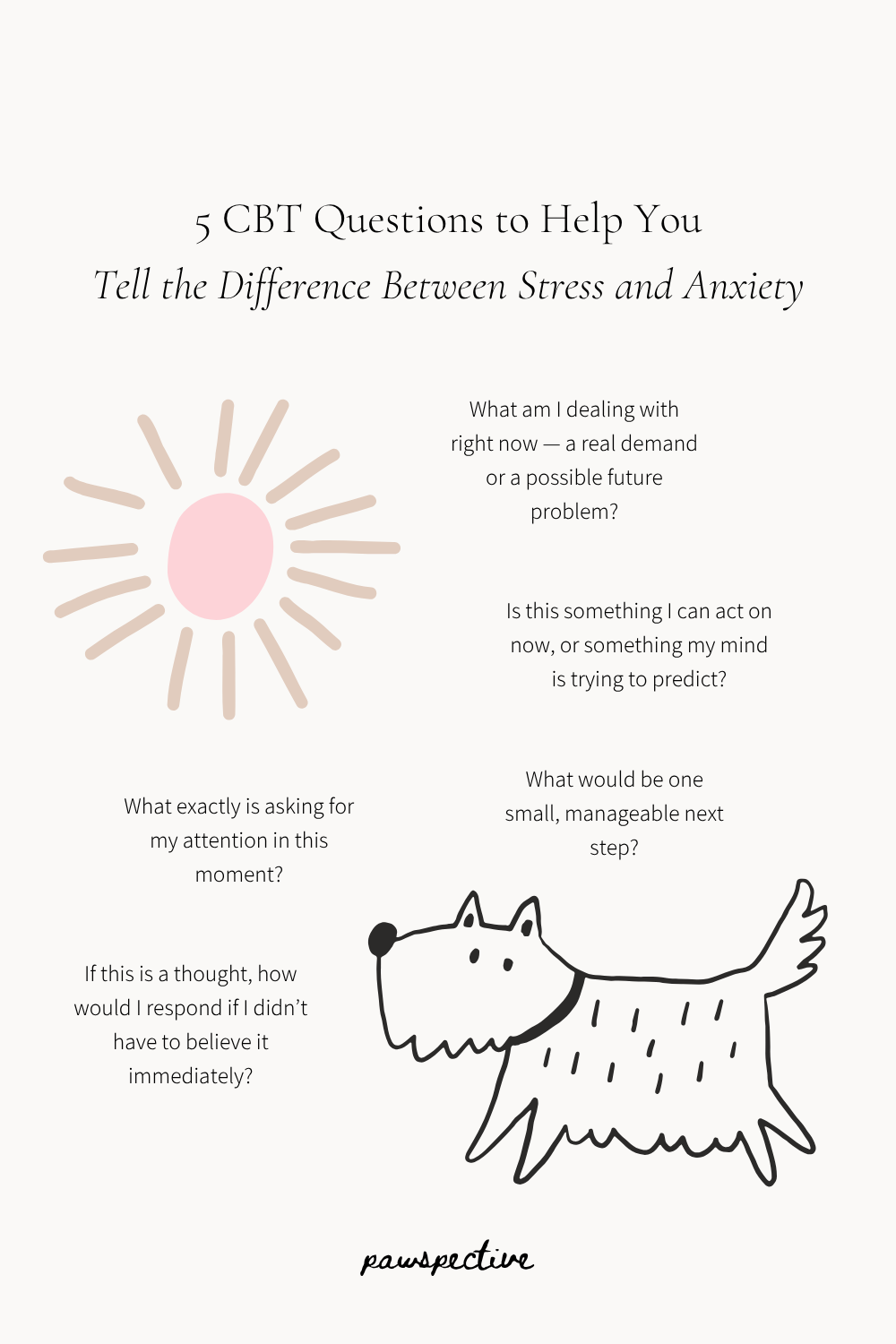
A small strategy to try: “Is this a demand or a danger?”
When you notice yourself becoming tense, revved up, or mentally spiralled, try asking one simple question:
Is this a present demand, or a future danger my mind is predicting?
This can help because it separates two experiences that often get tangled together. Once they are untangled, your response can become more accurate.
Use it when you notice:
racing thoughts
a sense of internal pressure
tension without clear direction
overwhelm at night
the feeling that your mind will not switch off
Here is how to try it.
1. Pause and name what is happening.
Ask yourself, “What is happening right now?”
2. Sort it gently.
Is this mainly something I need to respond to in the present? Or is my mind predicting something that has not happened?
3. If it is a demand, choose one small action.
Send the email. Write the list. Ask for help. Drink some water. Take the next practical step rather than trying to solve everything at once.
4. If it is a future threat, name it as a prediction.
You might say, “My mind is predicting that this will go badly.” That small shift helps create distance. It reminds you that a thought is not the same as a fact.
5. Loosen the body slightly.
Drop your shoulders. Unclench your jaw. Lengthen the out-breath. This is not about forcing calm. It is about signalling that you are orienting, not bracing.
A very small step you can try now
Finish the sentence: “At this moment, what I’m dealing with is…”
Then choose either one action if it is stress, or one sentence of perspective if it is anxiety.
A guided structure can sometimes help
When physical tension or anxiety appears regularly, many people find it helpful to practise calming techniques in a more structured way rather than trying to remember them in the moment.
In therapy, guided body-based exercises are often used to help the nervous system shift out of ongoing stress activation. One technique I frequently introduce is Progressive Muscle Relaxation, which helps people notice where tension sits in the body and gradually learn to release it.
For this reason, I created a therapy-informed tool that includes a step-by-step guided relaxation audio, a short explanation of how the technique works, and worksheets to help track tension patterns and integrate the practice into daily life.
If you would like structured guidance for practising this, you can explore it here:

Closing reflection
Stress and anxiety are not signs that you are failing. They are protective responses from a mind and body trying to manage pressure, uncertainty, and perceived threat.
The important shift is not learning how to never feel them. It is learning how to recognise what is happening more clearly. Sometimes you need practical support with the demands in front of you. Sometimes you need a different relationship with the fearful predictions your mind is generating. Often, you need both.
Psychological change usually begins there: with a little more clarity, a little less self-criticism, and small repeated moments of responding differently.
You might also find helpful



Safety note
This article is intended for educational purposes and does not replace professional mental health care. If you are experiencing significant distress or mental health difficulties, seeking support from a qualified professional can be an important step.
Sources & Further Reading
A-Tjak, J. G. L., Davis, M. L., Morina, N., Powers, M. B., Smits, J. A. J., & Emmelkamp, P. M. G. (2015). A meta-analysis of the efficacy of acceptance and commitment therapy for clinically relevant mental and physical health problems. Psychotherapy and Psychosomatics, 84(1), 30–36.
Behar, E., DiMarco, I. D., Hekler, E. B., Mohlman, J., & Staples, A. M. (2009). Current theoretical models of generalized anxiety disorder (GAD): Conceptual review and treatment implications. Journal of Anxiety Disorders, 23(8), 1011–1023.
Carpenter, J. K., Andrews, L. A., Witcraft, S. M., Powers, M. B., Smits, J. A. J., & Hofmann, S. G. (2018). Cognitive behavioral therapy for anxiety and related disorders: A meta-analysis of randomized placebo-controlled trials. Depression and Anxiety, 35(6), 502–514.
Cohen, S., Kamarck, T., & Mermelstein, R. (1983). A global measure of perceived stress. Journal of Health and Social Behavior, 24(4), 385–396.
Eysenck, M. W., Derakshan, N., Santos, R., & Calvo, M. G. (2007). Anxiety and cognitive performance: Attentional control theory. Emotion, 7(2), 336–353.
Hofmann, S. G., Sawyer, A. T., Fang, A., & Asnaani, A. (2012). Emotion dysregulation model of mood and anxiety disorders. Depression and Anxiety, 29(5), 409–416.
Twohig, M. P., & Levin, M. E. (2017). Acceptance and commitment therapy as a treatment for anxiety and depression: A review. Psychiatric Clinics of North America, 40(4), 751–770.
Wilson, E. J., Drost, C., & Chorpita, B. F. (2023). The impact of psychological treatment on intolerance of uncertainty in adults with generalized anxiety disorder: A systematic review and meta-analysis. Journal of Anxiety Disorders, 96, 102702.
