
Why Am I So Hard on Myself? Understanding the Psychology of Self-Criticism

You finish the task, send the message, get through the meeting, or make it to the end of a difficult day. Then the inner commentary begins. You should have handled that better. Why did you say it like that? Other people cope more easily. You are always behind.
For many people, self-criticism is not loud in a dramatic way. It can sound reasonable, familiar, even responsible. It may seem like the voice that keeps you trying, improving, and staying accountable. Yet over time it can become exhausting. Instead of helping you reflect, it keeps you tense. Instead of helping you grow, it leaves you feeling small, ashamed, or never quite enough.
In my work with clients, this pattern appears across many different difficulties. It often sits underneath anxiety, perfectionism, low mood, people-pleasing, burnout, and overthinking. Sometimes people come to therapy because they feel constantly under pressure, only to realise later that much of that pressure is coming from the way they speak to themselves.
Understanding self-criticism matters because it is not just a style of thinking. It shapes mood, behaviour, motivation, and the way a person treats themselves when life is already hard. Once the pattern becomes clearer, it is often possible to respond to it more wisely and less automatically. Self-criticism is widely understood as a clinically important, transdiagnostic process, meaning it shows up across many forms of psychological distress.
In this guide
In this article, you will learn:
What self-criticism actually is and how it shows up in everyday life
Why the mind develops this pattern in the first place
What many people misunderstand about being hard on themselves
How self-criticism is maintained over time
What often happens in therapy when this pattern begins to shift
Signs self-criticism may be affecting you more than you realise
Practical CBT and ACT strategies to begin changing the pattern
Small daily practices that can help build a steadier inner voice
What this experience actually is
Self-criticism is the tendency to relate to yourself through harsh judgement, blame, dismissal, or attack, especially when you feel inadequate, make mistakes, fall short of your standards, or simply struggle in ways that feel uncomfortable. It is more than noticing that something did not go well. It is the added message that the difficulty says something negative about who you are.
That message can sound obvious, such as: “I am useless.” “That was pathetic.” “I should be better than this.” But it can also sound quieter and more acceptable on the surface: “I am just being honest with myself.” “I cannot afford to go easy on myself.” “This is what keeps me functioning.”
Many people I meet in practice describe it as a constant internal pressure. They work hard but rarely feel satisfied. Compliments do not land. Mistakes linger for hours or days. Rest brings guilt rather than recovery. They can be deeply understanding with friends yet strikingly unforgiving with themselves.
A useful distinction is this: healthy self-reflection asks, “What happened, and what can I learn?” Self-criticism asks, “What happened, and what does it prove is wrong with me?” One helps with learning. The other tends to trigger shame, fear, and defensiveness.
In CBT terms, self-criticism often links with automatic thoughts and deeper core beliefs. Automatic thoughts are the quick, often habitual interpretations that flash through the mind in specific situations. Core beliefs are broader, more settled conclusions a person may carry about themselves, such as “I am not good enough”, “I am a burden”, or “I only matter if I perform well”. CBT theory and practice place these kinds of beliefs and interpretations at the centre of emotional distress and behaviour change.
If self-criticism is closely tied to emotional overwhelm, Emotional Regulation: Why Emotions Come in Waves may also support you.
Why the mind develops this pattern
People are rarely self-critical for no reason. The pattern usually develops because, at some point, it made a kind of psychological sense.
Self-criticism as a strategy for preventing pain
One common mechanism is that the mind begins to use criticism as a way of staying safe. If mistakes once led to embarrassment, rejection, conflict, disapproval, or loss of connection, the brain learns to anticipate those risks. It may then try to protect you by becoming harsh first.
The internal logic often sounds like this: if I push myself hard enough, I will not fail; if I spot my flaws early, nobody else can use them against me; if I stay dissatisfied, I will keep improving. In this sense, self-criticism is often less about cruelty and more about threat management. The problem is that it becomes an exhausting and costly form of protection. Research and theory in compassion-focused work describe self-criticism as closely linked with threat-based processing and increased vulnerability to depression and other forms of distress.
Internalised voices and conditional acceptance
A second mechanism has to do with learning. People often absorb ways of being treated and later replay them internally. This does not only happen in obviously critical or harsh families. It can develop wherever love, approval, or safety feels conditional. Perhaps achievement was heavily rewarded. Perhaps mistakes felt unsafe. Perhaps emotions were minimised, mocked, or treated as weakness. Perhaps vulnerability was tolerated only if it was brief and tidy.
Over time, the mind may internalise the message that worth depends on coping well, performing well, or not causing inconvenience. That message then begins to sound like your own voice.
Not everyone with strong self-criticism has a clear memory of where it began. Sometimes it is shaped by school, culture, peer comparison, work environments, or repeated experiences of not feeling enough. What matters clinically is that the inner critic often reflects learned rules rather than objective truth.
Perfectionism, comparison, and cognitive fusion
For some people, self-criticism is closely tied to perfectionism. Perfectionism is not simply caring about standards. Clinically, it becomes a problem when self-worth becomes overly dependent on meeting demanding standards, and when falling short triggers harsh self-evaluation. Reviews of the literature have consistently linked perfectionism with a broad range of psychological difficulties.
ACT adds another useful idea here: cognitive fusion. This means becoming so entangled with thoughts that they are experienced as literal facts rather than passing mental events. When fused with self-critical thoughts, a person does not notice, “I am having the thought that I am failing.” Instead, the thought lands as plain truth: “I am failing.” ACT specifically aims to alter the impact of distressing thoughts by changing how a person relates to them, rather than treating every thought as something that must be obeyed or disproved.

What many people misunderstand
“Being hard on myself is what keeps me motivated”
This belief is extremely common. Many people fear that if they stop criticising themselves, they will become lazy, careless, or complacent. But there is an important difference between motivation and threat-driven pressure.
Threat can certainly make people act. It can push, tighten, and mobilise. But it often does so at a cost: anxiety, exhaustion, procrastination, avoidance, and a constant sense of never arriving. A mind that feels attacked does not always learn well. Sometimes it simply becomes more frightened.
“Self-criticism is just honesty”
Self-criticism often presents itself as realism. But psychologically it is usually selective and distorted. It zooms in on shortcomings, minimises context, and makes sweeping character judgements from limited evidence. It does not sound like fair observation. It sounds like prosecution.
“If I feel ashamed, I must have done something wrong”
Shame is not always a reliable moral guide. People can feel ashamed for needing help, resting, feeling hurt, being sensitive, setting boundaries, or not meeting impossible standards. The feeling of shame does not necessarily mean you are failing. It may simply mean a self-critical system has been activated.
“I just need to improve enough and the critic will go away”
Often the goalposts move. If self-worth depends on performance, then success rarely feels secure for long. People meet one standard and immediately create another. This is one reason perfectionism and self-criticism can be so relentless. Even achievement does not bring much peace, because the underlying rule has not changed.
How the pattern is maintained
Self-criticism tends to run in a cycle.
A trigger occurs. You make a mistake, feel emotionally exposed, compare yourself with someone else, receive ambiguous feedback, or simply have a tired, difficult day. The mind generates a self-critical interpretation: “You are not handling this well.” “You always do this.” “You should be better by now.”
That interpretation affects mood and the body. Shame may rise. Anxiety may tighten. Energy may drop. Once that internal state changes, the mind becomes even more likely to generate similar thoughts. This is one of the reasons the pattern can gather momentum quickly.
Behaviour then shifts. Some people overcompensate. They overwork, overprepare, overexplain, apologise quickly, or chase reassurance. Others pull back. They procrastinate, avoid, isolate, or stop trying because getting it wrong feels too exposing.
Both responses can keep the cycle going. Overcompensating tells the brain, “This threat was real; we must keep scanning.” Avoidance tells the brain, “You were right to be afraid; you could not cope.” Short-term relief reinforces the longer-term pattern. CBT describes these maintenance loops as central to how distress persists over time.
There is usually an attentional bias as well. When self-criticism is active, the mind notices evidence that fits the harsh story and filters out what does not. One awkward moment becomes proof. Ten ordinary or decent moments disappear into the background.
Therapist perspective
In therapy, self-criticism is often more woven into daily life than people initially realise. Someone may come because of anxiety, low mood, or burnout, yet the language they use about themselves reveals an almost constant undercurrent of attack.
A client might describe feeling overwhelmed and then call themselves weak. They might need rest but interpret that as laziness. They may speak of feeling hurt, disappointed, or afraid, and then immediately add a second layer of judgement: “I should not feel like this.” “Other people cope.” “I am making too much of it.”
What is striking is not only the content of the thoughts, but the relationship to the self. Many people are speaking to themselves in ways they would never use with someone they love.
Another pattern I often see is the confusion of self-punishment with responsibility. People believe that criticising themselves proves they care, keeps them grounded, or prevents selfishness. Often there is fear underneath: fear of losing control, being rejected, seeming arrogant, or letting standards slip.
Common turning points in therapy do not usually involve eliminating the inner critic overnight. More often, the shift begins when people recognise that the critic is doing a job. It is usually trying to prevent pain, not simply telling the truth. That realisation can reduce shame and create enough space to ask a new question: if this strategy is meant to protect me, is it actually helping?
Another important turning point comes when clients experience that compassion does not reduce accountability. In many cases, it improves it. A person who is less threatened internally is often more able to reflect honestly, repair mistakes, and keep going without collapsing into either avoidance or self-attack. Evidence from meta-analytic work suggests that self-compassion-related interventions can meaningfully reduce self-criticism, which fits closely with what many clinicians observe in practice.
Signs this pattern may be affecting you
You may recognise some of the following:
You dismiss praise quickly but remember criticism for a long time.
You feel relief more often than satisfaction when you do something well.
You use a lot of “should” language about emotions, productivity, or coping.
You replay conversations and focus on what you said imperfectly.
You struggle to rest without guilt.
You often compare yourself with others and come out worse in the comparison.
Small mistakes feel heavier than they need to.
You apologise quickly or excessively.
You assume difficulty means weakness, rather than seeing it as part of being human.
You find it easier to understand others than yourself.
You worry that kindness towards yourself would make you less disciplined.
You link your worth too closely to achievement, usefulness, or approval.
These are not diagnostic criteria. They are everyday signs that the relationship you have with yourself may be shaped by criticism more than you realise.
Practical ways to begin changing the pattern
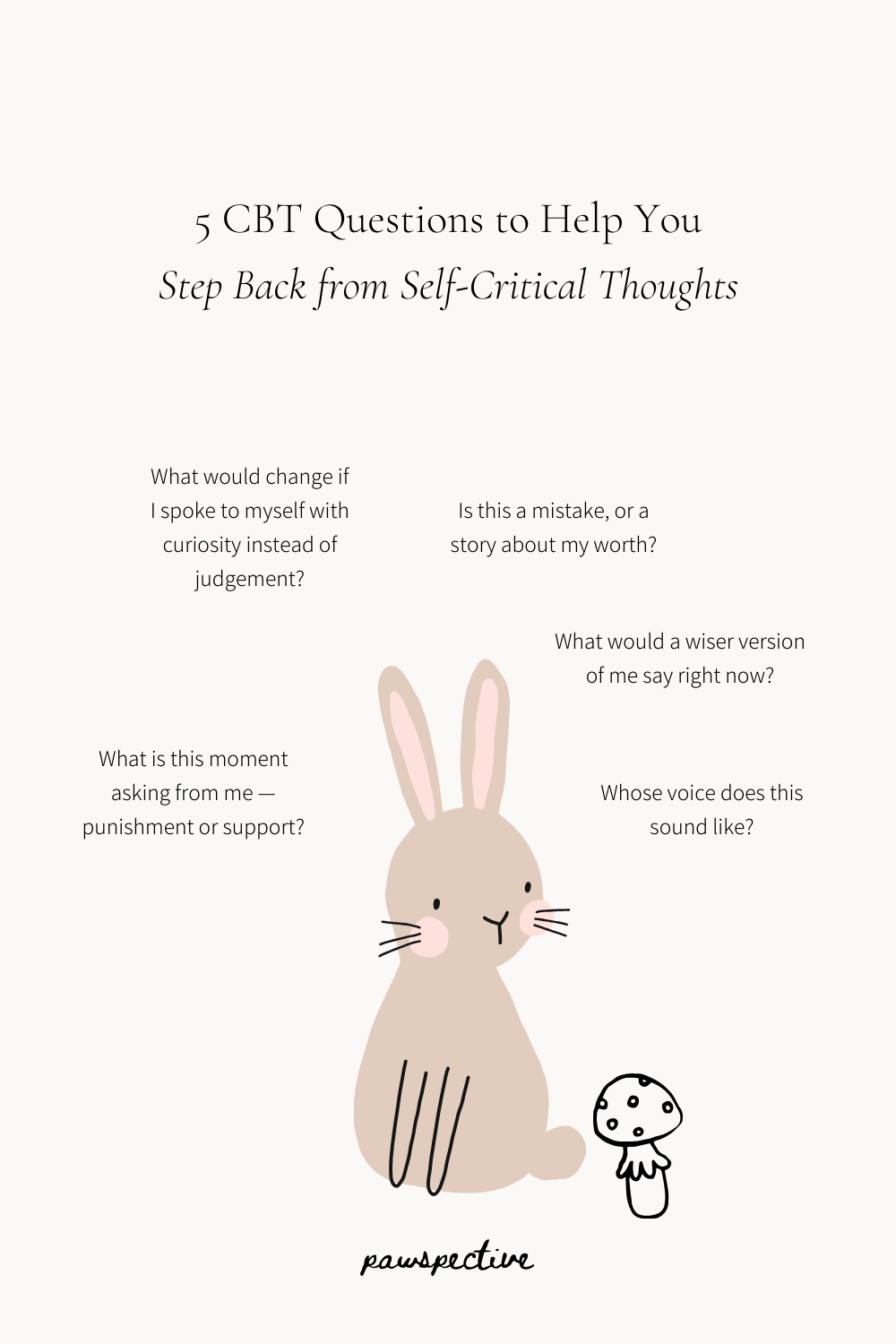
1. Notice and name the critical thought
Self-criticism often happens so quickly that it feels like truth rather than a thought. One of the first helpful steps is to slow the process down enough to notice what your mind is saying. In CBT and ACT, this matters because naming a thought creates a little distance from it. Instead of being fully inside the criticism, you begin to observe it.
This can be especially useful after a mistake, during moments of shame, or whenever you hear strong internal messages such as “I should be better” or “I always get things wrong”.
Small step to try now:
Pause for a moment and notice one self-critical thought you have had today. Then rephrase it as: “I am noticing the thought that…” or “My inner critic is saying…”.
2. Ask what the critic is trying to do
Although self-criticism feels harsh, it is often trying to protect you in some way. For many people, the critic is attempting to prevent failure, rejection, disappointment, or loss of control. Asking what it is trying to do can help you understand the pattern with more clarity and less shame.
This does not mean the critic is helpful. It simply means there is often a fear underneath it. When you understand that fear, it becomes easier to respond more intentionally rather than automatically believing the criticism.
Small step to try now:
Ask yourself: “What is this critical voice trying to protect me from right now?” Write down the first honest answer that comes to mind.
3. Practise a balanced response instead of a harsh one
Self-critical thoughts are often extreme, unfair, and incomplete. They tend to ignore context, effort, and ordinary human difficulty. A more helpful alternative is not forced positivity, but a balanced response. This means speaking to yourself in a way that is more accurate, fair, and grounded.
In CBT, this kind of reframing helps loosen all-or-nothing thinking and reduces the emotional intensity that comes from harsh self-judgement. It can be especially useful after awkward conversations, setbacks, or emotionally difficult days.
Small step to try now:
Take one self-critical thought and ask: “What would be a fairer way to describe this situation?” Write one balanced sentence that includes both honesty and context.
4. Respond with compassionate accountability
Many people assume they must choose between being kind to themselves and taking responsibility. In reality, both can exist together. Compassionate accountability means acknowledging what happened honestly, while responding in a steadier and less attacking way.
This approach can help because people are often more able to reflect, repair, and learn when they do not feel internally punished. It is especially useful when shame is high or when you notice yourself moving between self-attack and avoidance.
Small step to try now:
Use this simple sentence structure: “This is hard, but I can respond usefully.” Then ask yourself what one small next step would actually help.
Small practices for everyday life
Change is often built through ordinary repetition rather than dramatic breakthroughs.
Listen for tone, not just content. Ask yourself once or twice a day: how am I speaking to myself right now?
Reduce unnecessary “shoulds”. Replace “I should be coping better” with “I wish this felt easier” or “I am finding this hard today.”
Keep a balanced evidence note. Write down one thing each day that reflects effort, courage, learning, or care. This helps correct the mind’s bias towards deficiency.
Pause before dismissing kindness. When somebody thanks you or says you did something well, notice the urge to argue with it. You do not need to force belief. Just notice the reflex.
Build recovery into your standards. Any standard that leaves no room for tiredness, grief, mistakes, or stress may need reviewing.
A guided structure can sometimes help
In my daily clinical work, I often see how helpful it can be for people to practise two skills at the same time: creating a little distance from unhelpful thoughts, and developing a steadier, more supportive inner voice. Many people discover that the critic becomes less powerful once these two abilities begin to grow.
One way of practising psychological distance is through a short guided reflection such as Calming Thoughts. Exercises like this help people notice when the mind starts spiralling, gently step back from the stream of thoughts, and observe them rather than immediately believing or reacting to them.
You can explore it here:
Calming Thoughts Practice Kit
Alongside this, I often teach clients self-compassion practices. These exercises focus on learning how to respond to difficult moments with the same understanding and steadiness we would usually offer to someone we care about. Over time, this can help people practise a more helpful internal voice instead of the automatic critic.
You can explore it here:
Soothing Heavy Moments Practice Kit
Closing reflection
Self-criticism often sounds like truth, but very often it is fear, learning history, and threat management wrapped in a familiar voice. The aim is not to become unrealistically positive or to stop caring about your behaviour. It is to build a way of relating to yourself that is honest without being brutal.
Psychological change often begins quietly. You notice the tone. You name the thought. You pause before agreeing with it. You choose one fairer sentence. You repeat that process often enough that a different internal pattern begins to feel possible.
You might also find helpful



Safety note
This article is intended for educational purposes and does not replace professional mental health care. If you are experiencing significant distress or mental health difficulties, seeking support from a qualified professional can be an important step.
Sources & Further Reading
Beck, J. S. (2021). Cognitive behavior therapy: Basics and beyond (3rd ed.). Guilford Press.
Gilbert, P. (2009). The compassionate mind. Constable.
Gilbert, P., Clarke, M., Hempel, S., Miles, J. N. V., & Irons, C. (2004). Criticizing and reassuring oneself: An exploration of forms, styles and reasons in female students. British Journal of Clinical Psychology, 43(1), 31–50.
Greenberger, D., & Padesky, C. A. (2016). Mind over mood: Change how you feel by changing the way you think (2nd ed.). Guilford Press.
Hayes, S. C., Strosahl, K. D., & Wilson, K. G. (2011). Acceptance and commitment therapy: The process and practice of mindful change (2nd ed.). Guilford Press.
Halamová, J., Kanovský, M., Varšová, K., & Kupeli, N. (2020). Randomised controlled trial of an online version of compassion mind training for improving self-criticism and self-compassion. Current Psychology. Advance online publication.
Neff, K. D. (2003). Self-compassion: An alternative conceptualization of a healthy attitude toward oneself. Self and Identity, 2(2), 85–101.
Shafran, R., Cooper, Z., & Fairburn, C. G. (2002). Perfectionism and psychopathology: A review of research and treatment. Clinical Psychology Review, 22(7), 879–906.
Wakelin, K. E., Perman, G., & Simonds, L. M. (2022). Effectiveness of self-compassion-related interventions for reducing self-criticism: A systematic review and meta-analysis. Clinical Psychology & Psychotherapy, 29(1), 1–25.
Zaccari, V., Mancini, F., & Gangemi, A. (2024). State of the art of the literature on definitions of self-criticism: A meta-review. Frontiers in Psychiatry, 15, Article 1239696.
