
Understanding Stress and Mental Overload: Why Your Mind Feels Full and What Helps

Sometimes stress does not feel dramatic. It feels like your mind is carrying too many tabs at once.
A message you still need to answer. A task you have not finished. A decision you keep postponing. The sense that even when you stop, your mind does not.
Many people describe it in similar ways:
“I’m exhausted, but I still can’t switch off.”
“My brain feels full.”
“I’m not even sure what’s wrong. I just feel mentally overloaded.”
That experience can be hard to explain, especially when nothing looks obviously wrong from the outside. You may still be functioning. You may still be getting things done. But inside, everything can start to feel crowded, effortful, and strangely hard to hold.
Often, this is not simply “being busy”. It is mental overload: a state in which too many demands are competing for your attention, emotional capacity, decision-making, and practical energy at the same time.
This matters because when people do not understand the pattern, they often turn against themselves. They assume they are disorganised, weak, lazy, or simply not coping properly. But very often, that is not the real problem.
More often, the mind is caught in a cycle of pressure, urgency, unfinished loops, and too little recovery. Once you can see that cycle more clearly, it becomes easier to respond with more accuracy and less self-blame.
In this guide
In this article, you will learn:
What stress and mental overload actually are, and why they are not quite the same thing
Why your mind can start to feel full, even when the tasks themselves seem ordinary
What people often misunderstand about overwhelm, overthinking, and coping
How overload keeps itself going, even when you are trying hard to manage it
What can begin to help, in ways that are practical, evidence-based, and realistic
What this experience actually is
Stress is often described as “having too much to do”. But that does not fully capture what many people are struggling with.
Often the harder part is not just the amount. It is the feeling that everything stays mentally open.
You may recognise this if:
your mind feels busy even when you are sitting still
you keep thinking about what you have forgotten
small tasks feel strangely hard to begin
you move between things without settling into any of them
rest feels guilty, incomplete, or difficult to sink into
everything feels urgent, even when you know logically it cannot all be urgent
This is where it helps to separate stress from mental overload.
Stress is the broader response that happens when the mind and body register demands as significant or difficult to manage.
Mental overload is the more specific experience of feeling that there is simply too much for your mind to process, organise, hold, or recover from at once.
That distinction matters, because overload is not only about quantity. It is also about fragmentation.
A person can have a very full week and still feel reasonably steady if things are clear, contained, and there is time to recover. But a day full of interruptions, half-finished tasks, emotional strain, uncertainty, and constant switching can feel far more overwhelming.
So when your mind feels full, it is not always because you are doing life badly. Sometimes it is because your attention has been pulled in too many directions for too long, without enough structure or recovery to help you process it.
If you are unsure whether you are dealing with stress or anxiety, read Anxiety vs Stress – What’s the Difference?
Why the mind develops this pattern
Usually, there is a logic to this.
Your mind is trying to keep up. It is trying not to drop anything important. It is trying to anticipate problems, stay prepared, and maintain some sense of control. But under strain, the very strategies that are meant to help can start adding to the pressure.
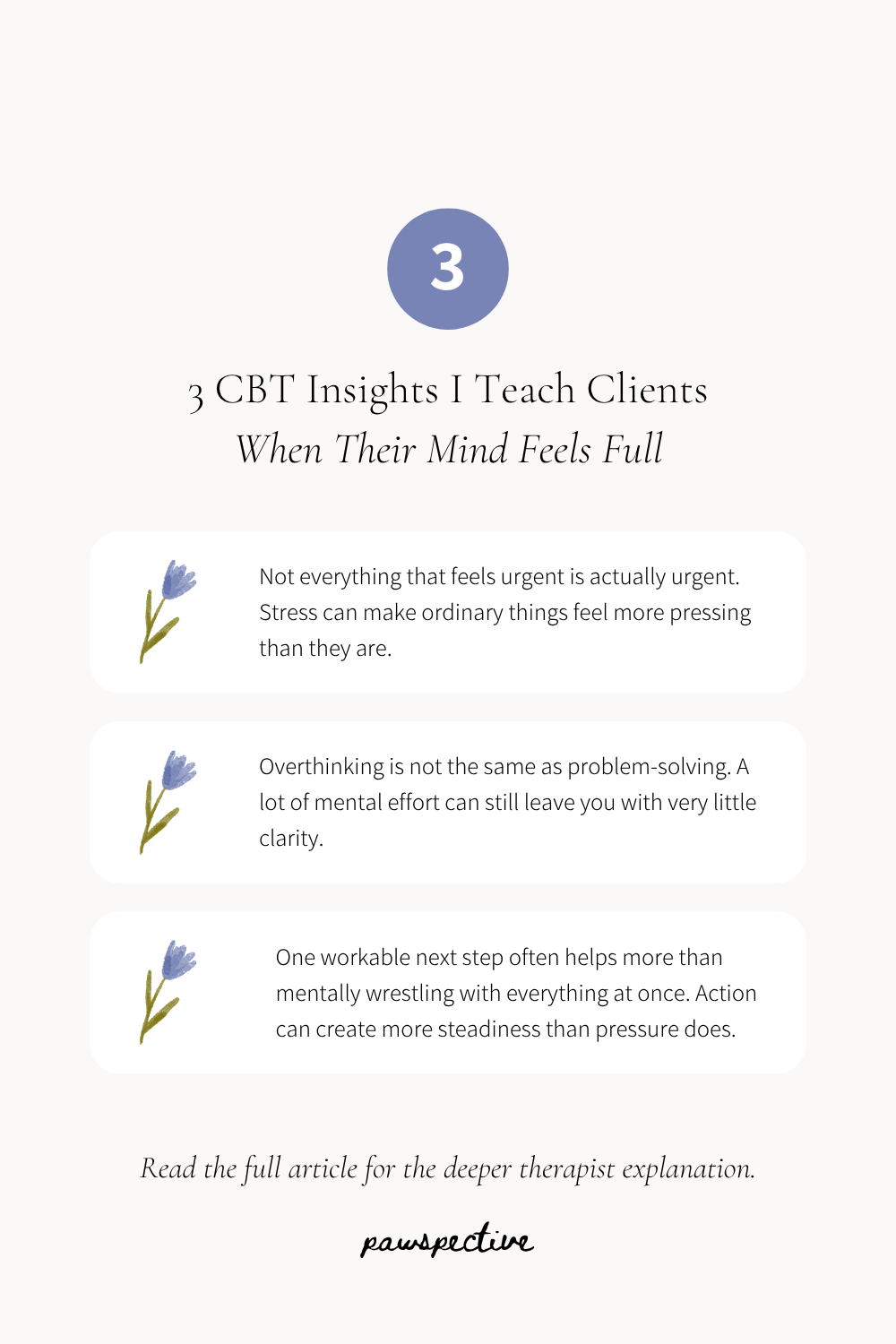
The mind starts reading things as more urgent than they are
In therapy, one useful idea from CBT is that stress is shaped not only by what is happening, but by how the mind interprets what is happening.
When you are already under strain, an unfinished task is no longer just unfinished. It can start to carry extra meaning:
“I’m already behind.”
“I should be handling this better.”
“If I don’t sort this now, everything will get worse.”
“There’s no room for error.”
That added meaning increases pressure. It narrows attention and makes it harder to think clearly.
This does not mean stress is “just a mindset problem”. External conditions matter. Sometimes the demands really are too high. But the mind’s appraisal still affects how overwhelmed the situation feels and how much urgency gets added on top.
Stress makes attention narrower and coping less flexible
When stress rises, attention becomes more threat-focused. The mind starts scanning for what is missing, what still needs doing, what might go wrong, and what has not yet been resolved.
That is why overloaded people often say:
“I can’t prioritise.”
“I keep jumping between things.”
“I don’t know where to start.”
“Even when I rest, my mind keeps returning to everything.”
This is not usually a simple lack of discipline. It is often a mind that has become too activated to sort things well.
Short-term relief can quietly maintain the pattern
When people feel overloaded, they often respond in very understandable ways:
overthinking
avoiding the heaviest task
checking and re-checking
multitasking
pushing through tiredness
telling themselves they can rest later
These responses often make sense in the moment. They may briefly create a feeling of movement or control. But they also tend to keep the mind switched on.
Avoidance leaves more unfinished loops.
Multitasking creates more fragmentation.
Overthinking feels productive, but often leads nowhere.
Skipping rest reduces the very capacity you need to cope.
So the mind ends up even fuller than before.

What many people misunderstand
“I’m just not coping well enough”
This is one of the most painful interpretations, and often one of the least accurate.
Mental overload is not usually a sign of weakness. It is more often what happens when real demands, emotional strain, uncertainty, and unhelpful coping patterns start building on each other.
“I just need to be more organised”
Sometimes practical organisation does help. But many overloaded people are not struggling because they are careless. They are struggling because their mind is trying to track too much at once.
The issue is often not just poor planning. It is constant internal monitoring.
“Once I feel calmer, I’ll start”
This sounds sensible, but it often keeps people stuck.
Many people wait to feel clear, settled, or mentally ready before beginning. But often, one small workable action is part of what helps the mind settle.
You do not always need to feel organised before taking the next step. Sometimes the next step is what creates a little more organisation inside.
“If I think about it long enough, I’ll finally feel in control”
Careful thought can help. But rumination is different.
Rumination is the kind of thinking that circles without moving. It often sounds like:
“Why am I like this?”
“What if I can’t cope?”
“I need to figure everything out before I do anything.”
It gives the feeling of mental effort without much resolution. And it often leaves you more drained, not more prepared.
How the pattern is maintained
Mental overload often becomes self-reinforcing.
Something feels demanding. Then the mind adds urgency:
“I need to do everything.”
“There’s no time to stop.”
“If I miss one thing, it will all unravel.”
That pressure increases tension. Clear thinking gets harder. The person starts scanning, switching, postponing, overthinking, or pushing through.
These responses may give short-term relief or a brief sense of control. But they usually create long-term costs:
more unfinished tasks
less clarity
less recovery
more guilt about resting
a stronger feeling of falling behind
At that point, many people start blaming themselves for struggling, which adds another layer of pressure.
This is why overload can feel so defeating. It is not just the original stress. It is the cycle that forms around it.
Therapist perspective
In therapy, this often looks less like “being bad at life” and more like being caught in a pattern that once made sense.
The person who procrastinates may be overwhelmed and afraid of getting something wrong.
The person who cannot switch off may have trained themselves to stay mentally alert for too long.
The person who keeps overthinking may be trying, in a very human way, to create certainty where there is not much of it.
These patterns are rarely random. They are usually attempts to cope, protect, prepare, or stay in control.
In my work with clients, I often notice that the self-criticism arrives very quickly. People call themselves lazy, chaotic, weak, or dramatic, when what I can often see more clearly is a mind under strain, trying hard in ways that are no longer helping.
That is why self-criticism usually misses the point. If we describe overload as laziness or poor discipline, we tend to choose the wrong solution. We push harder when what is actually needed may be more clarity, more containment, less fragmentation, or more deliberate recovery.
Often, change begins with a small but meaningful shift in recognition:
realising that frantic task-switching is not the same as productivity
noticing that overthinking is not the same as problem-solving
seeing that rest is part of coping, not the reward for perfect coping
taking one clear next step instead of mentally wrestling with everything at once
These shifts may seem small, but they are often where relief begins.
Signs this pattern may be affecting you
You may recognise this pattern if:
your mind feels constantly busy, even when you are not doing anything
you struggle to stay with one task
you feel behind most of the time
rest feels uncomfortable or guilty
small tasks feel bigger than they should
you keep thinking without reaching a decision
you avoid certain things because they already feel mentally heavy
you feel more irritable, tearful, or thin-skinned than usual
you cut breaks, sleep, or downtime because it feels like there is no room for them
you keep telling yourself that once everything is done, you will finally relax, but that point never arrives
None of this automatically means something severe is wrong. But it may mean that your current load, and the way you are trying to manage it, are no longer working well together.
Practical ways to begin changing the pattern
The goal is not to eliminate all stress. It is to reduce the patterns that keep your mind overloaded.
1. Reduce what your mind has to hold
When your mind feels full, try to reduce internal tracking.
That might mean:
writing tasks down instead of holding them mentally
making a short list for today rather than carrying the whole week
grouping similar tasks together
closing unnecessary tabs and notifications
creating a separate list for things you are not dealing with yet
This helps because your mind no longer has to keep scanning for everything at once.
2. Question the feeling of urgency
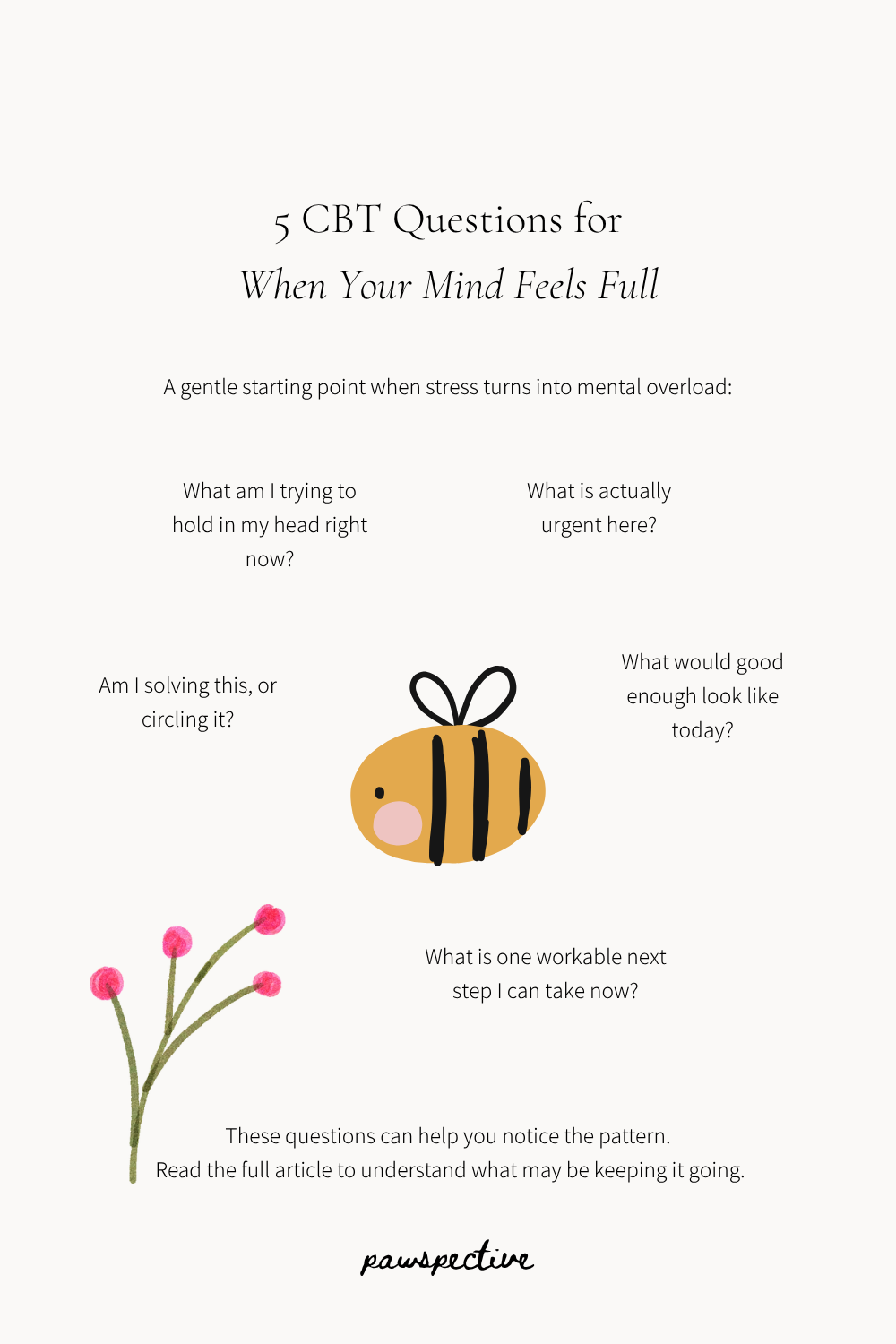
When everything feels pressing, pause and ask:
What is actually urgent here?
What is uncomfortable, but not urgent?
What standard am I applying to myself right now?
What would “good enough” look like today?
What is one thing I can do this afternoon, not in theory, but in reality?
These questions help shift the mind from panic-driven interpretation to something more accurate and workable.
3. Notice when thinking has stopped being useful
Ask yourself:
Is this helping me decide something?
Does this thought lead to a clear next step?
Am I solving, or circling?
If you are circling, it may help to move into:
a written next step
a grounding exercise
one small practical action
4. Take the next workable step before you feel fully ready
Instead of asking, “How do I fix all of this?”, try asking:
What is the next workable step I can take with the mind I have right now?
That might be:
opening the document
answering one message
setting a ten-minute timer
naming the decision you need to make
asking for help or clarification
This matters because action often reduces helplessness. It reminds the mind that discomfort can be present without stopping you completely.
Small practices for everyday life
Sometimes what helps most is not one dramatic change, but small forms of containment repeated consistently.
You might try:
a daily brain-dump list to get tasks out of your head
short pauses between work, errands, or evening tasks
ten minutes of single-tasking instead of constant switching
asking “What matters most now?” instead of “How do I do everything?”
noticing your early overload signs, such as irritability, doom-scrolling, avoidance, or racing thoughts
treating rest as part of staying functional, not something you have to earn after collapse
These practices are not about becoming perfectly calm. They are about helping your system come out of constant threat-management mode.
A guided structure can sometimes help
When stress is ongoing, the body often starts holding tension automatically. By the time many people notice it, they are already feeling wired, tired, or mentally overloaded. In those moments, it can be hard to remember what helps.
In therapy, guided body-based practices are often used to help people slow things down and reconnect with physical signs of stress earlier. One technique I often return to is Progressive Muscle Relaxation, because it helps people notice where they are bracing, clenching, or holding themselves tightly, and gradually practise releasing that tension with more awareness.
To support that process, I created The Release Practice — Guided Practice Kit. It includes a guided relaxation audio, a brief explanation of how the technique works, and reflective worksheets to help you notice your own tension patterns and practise the exercise more consistently in daily life.
You can explore it here:

Closing reflection
If your mind feels full, it does not automatically mean you are failing.
It may mean that too many things have stayed mentally open for too long. It may mean stress has become mixed with urgency, self-pressure, and not enough recovery. It may mean your mind is trying very hard to keep up in ways that are understandable, but no longer helping.
The answer is not always to push harder.
Often the first real shift is quieter than that.
You notice that your mind is carrying too much.
You stop calling that weakness.
You write one thing down instead of holding ten in your head.
You take one next step without waiting to feel fully ready.
You let rest count before everything is finished.
Those moments may look small. But they are often where a more manageable way of living begins.
You might also find helpful



Safety note
This article is intended for educational purposes and does not replace professional mental health care. If you are experiencing significant distress or mental health difficulties, seeking support from a qualified professional can be an important step.
Sources & Further Reading
Aldao, A., Nolen-Hoeksema, S., & Schweizer, S. (2010). Emotion-regulation strategies across psychopathology: A meta-analytic review. Clinical Psychology Review, 30(2), 217–237. https://doi.org/10.1016/j.cpr.2009.11.004
Butler, A. C., Chapman, J. E., Forman, E. M., & Beck, A. T. (2006). The empirical status of cognitive-behavioral therapy: A review of meta-analyses. Clinical Psychology Review, 26(1), 17–31. https://doi.org/10.1016/j.cpr.2005.07.003
Gross, J. J. (1998). The emerging field of emotion regulation: An integrative review. Review of General Psychology, 2(3), 271–299. https://doi.org/10.1037/1089-2680.2.3.271
Hayes, S. C., Strosahl, K. D., & Wilson, K. G. (2012). Acceptance and commitment therapy: The process and practice of mindful change (2nd ed.). Guilford Press.
Hofmann, S. G., Asnaani, A., Vonk, I. J. J., Sawyer, A. T., & Fang, A. (2012). The efficacy of cognitive behavioral therapy: A review of meta-analyses. Cognitive Therapy and Research, 36(5), 427–440. https://doi.org/10.1007/s10608-012-9476-1
Lazarus, R. S., & Folkman, S. (1984). Stress, appraisal, and coping. Springer.
McRae, K., & Gross, J. J. (2020). Emotion regulation. Emotion, 20(1), 1–9. https://doi.org/10.1037/emo0000703
Nolen-Hoeksema, S., Wisco, B. E., & Lyubomirsky, S. (2008). Rethinking rumination. Perspectives on Psychological Science, 3(5), 400–424. https://doi.org/10.1111/j.1745-6924.2008.00088.x
Ruiz, F. J. (2010). A review of acceptance and commitment therapy (ACT) empirical evidence: Correlational, experimental psychopathology, component and outcome studies. International Journal of Psychology and Psychological Therapy, 10(1), 125–162.
Troy, A. S., Shallcross, A. J., & Mauss, I. B. (2013). A person-by-situation approach to emotion regulation: Cognitive reappraisal can either help or hurt, depending on the context. Psychological Science, 24(12), 2505–2514. https://doi.org/10.1177/0956797613496434
