
Emotional Regulation: Why Emotions Come in Waves (and How to Ride Them)

There are days when emotions seem manageable and steady. And then there are moments when feelings appear to rise suddenly — irritation during a small conversation, a wave of sadness while walking home, or anxiety that seems to build without a clear reason.
Many people describe a similar experience: emotions that feel unpredictable, sometimes intense, and difficult to settle once they appear. One moment things feel calm, and the next the inner landscape has shifted. It can leave people wondering whether something is wrong with them or whether they are “too emotional”.
Yet when we look more closely at how the human mind and nervous system work, emotional waves are not unusual at all. In fact, they are part of how the emotional system is designed to function.
Understanding emotional regulation — the process through which we experience, interpret, and respond to emotions — can help people relate to these waves in a more supportive way. Rather than seeing emotions as problems that must be controlled or eliminated, psychological research suggests they are signals that can be noticed, understood, and gradually guided.
In therapeutic work, one of the most helpful shifts people make is learning that emotions do not need to be fought in order to change. Often they begin to settle when they are understood.
In this guide
In this article, you will learn:
• Why emotions naturally rise and fall in waves
• What emotional regulation actually means
• Why the mind sometimes struggles to settle strong feelings
• Common misunderstandings about emotions
• The cycle that can keep emotional overwhelm going
• Signs emotional regulation may be challenging for you
• Practical CBT and ACT strategies to work with emotions more effectively
• Small daily practices that support emotional balance
What emotional regulation actually is
Emotional regulation refers to the ways people influence which emotions they experience, when those emotions arise, and how they are expressed or responded to.
This does not mean controlling emotions in the sense of suppressing them. Instead, emotional regulation involves a set of psychological skills that help people notice, understand, and respond to emotional experiences.
Psychologists often describe emotions as short-lived responses generated by the brain when something meaningful happens. These responses involve several systems working together:
• thoughts and interpretations
• bodily sensations
• urges to act
• attention and memory
• behavioural responses
Because emotions involve the body and the mind simultaneously, they often feel powerful and immediate.
Many people I meet in practice describe moments such as:
• feeling suddenly overwhelmed by irritation during a stressful day
• noticing anxiety building after a difficult conversation
• replaying an upsetting interaction for hours
• feeling emotionally “flooded” and unsure how to calm down
None of these experiences mean that a person is weak or overly sensitive. They simply reflect how the emotional system responds to meaning, stress, relationships, and perceived threats.
Emotions are not random events. They are adaptive signals that evolved to help humans respond to their environment.
Fear prepares the body to respond to danger.
Anger mobilises energy when boundaries feel threatened.
Sadness signals loss and encourages reflection or support seeking.
The challenge is not that emotions occur — the challenge is often how we interpret and respond to them.
If emotions often feel too intense to manage, read Why Emotions Sometimes Feel Overwhelming.
If strong emotions quickly turn into self-criticism, Why We Are So Hard on Ourselvesmay also be relevant.
If stress makes emotions harder to regulate, Understanding Stress and Mental Overload may help connect the dots.
Why emotions come in waves
One of the most helpful insights from affective science is that emotions tend to move through natural cycles.
A typical emotional episode often follows this pattern:
A trigger occurs (an event, thought, memory, or body sensation).
The brain interprets the meaning of the situation.
The body produces emotional signals.
The mind begins reacting through thoughts or behaviours.
In many situations, emotions naturally rise, peak, and gradually settle.
However, when the mind becomes caught in certain patterns — such as rumination, avoidance, or self-criticism — emotional waves may last longer or feel stronger.
Three psychological processes are particularly relevant here.
Attentional focus
When attention locks onto a feeling or problem, the mind begins scanning for further evidence related to it.
Someone who notices anxiety may start monitoring their body closely.
Someone feeling hurt may replay a conversation repeatedly.
This attentional narrowing can unintentionally amplify emotional intensity.
Interpretation patterns
The brain is constantly interpreting situations.
A racing heart may be interpreted as danger.
A short message from a friend may be interpreted as rejection.
In CBT this process is sometimes called cognitive appraisal — the meaning the mind assigns to events.
These interpretations strongly influence emotional responses.
Nervous system activation
Emotions are closely tied to the nervous system.
When the brain perceives stress or threat, the sympathetic nervous system activates the body for action. Heart rate increases, breathing changes, and attention narrows.
If the nervous system remains activated, emotions can feel difficult to settle.
Understanding this physiological component often helps people realise that emotional waves are not simply “in the mind”. They involve the body as well.
What many people misunderstand about emotions
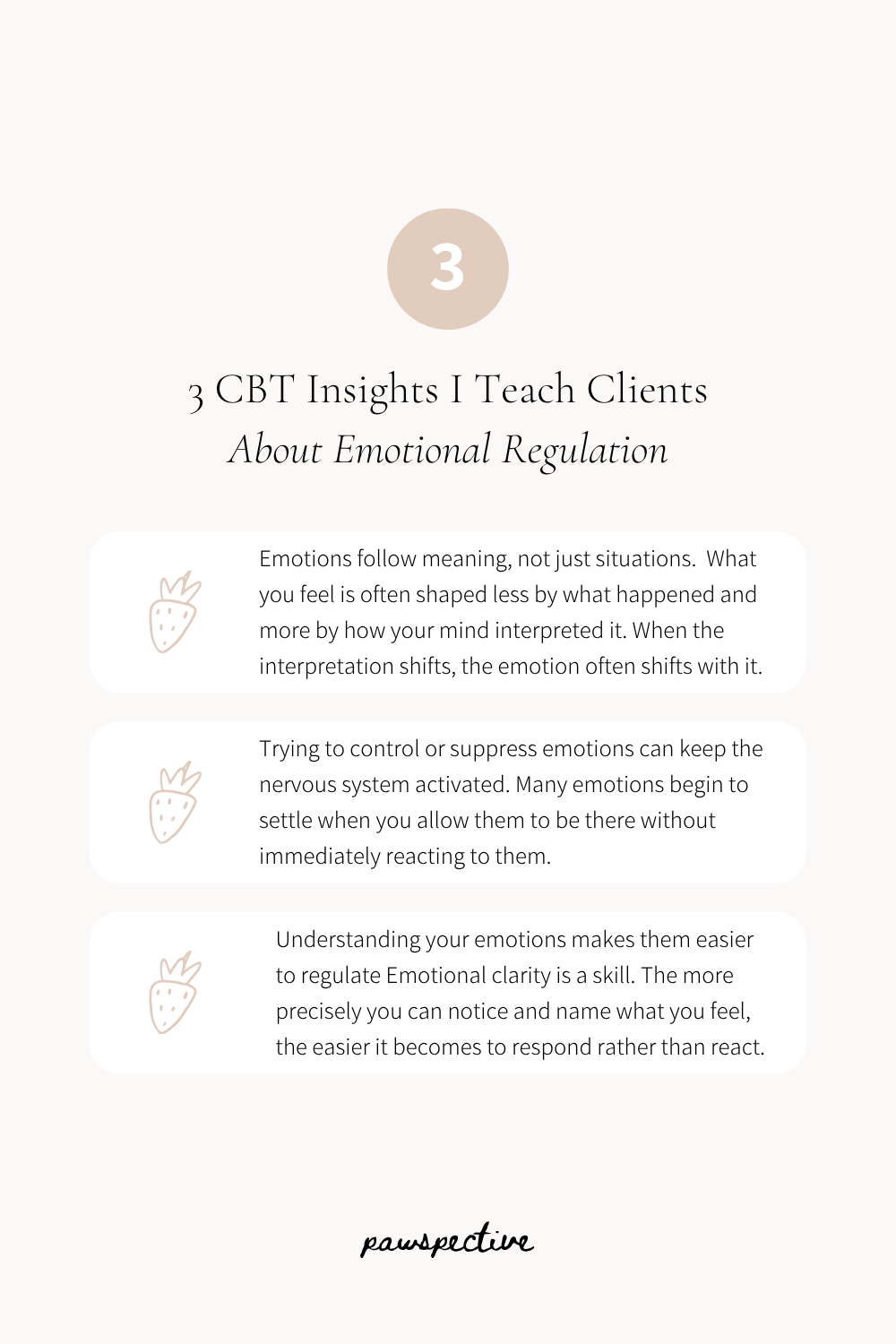
Several common beliefs about emotions can unintentionally make emotional experiences more difficult.
“Strong emotions mean something is wrong with me.”
In reality, emotional intensity often reflects how meaningful a situation is to someone. Sensitive emotional systems can also be connected to empathy, creativity, and strong relational awareness.
“I should be able to control my emotions immediately.”
Emotions do not respond well to force. Attempts to suppress or eliminate feelings often make them rebound more strongly.
“If I ignore the feeling, it will disappear.”
Avoidance sometimes works temporarily, but unprocessed emotions tend to return later — often in different forms such as tension, irritability, or fatigue.
A more helpful perspective is to view emotions as temporary internal signals rather than permanent states.
The cycle that can maintain emotional overwhelm
In therapeutic conversations, it often becomes clear that emotional waves themselves are not the main difficulty.
The challenge is the secondary reactions people have toward their emotions.
A simplified cycle might look like this:
Emotion appears (for example anxiety).
The mind interprets the emotion as dangerous or unacceptable.
Attempts are made to suppress, analyse, or avoid the feeling.
Attention becomes increasingly focused on the emotion.
The nervous system remains activated.
This cycle can keep emotional states going far longer than the original trigger would have.
Over time, people may become worried about their emotions themselves, which creates another layer of stress.
Therapist perspective
Across many conversations in therapy, a similar pattern appears.
People often come into sessions believing their emotions are unpredictable or uncontrollable. They may describe feeling overwhelmed, ashamed of their reactions, or frustrated that their mind “won’t switch off”.
Yet when we begin exploring emotional patterns slowly and with curiosity, something interesting often happens.
Clients begin noticing that emotions actually follow recognisable sequences.
There may be early body signals before anxiety builds.
There may be certain interpretations that intensify anger.
There may be avoidance behaviours that prolong sadness.
When these patterns become visible, emotions often start feeling less mysterious.
One of the most meaningful turning points in therapeutic work is when people shift from trying to eliminate emotions to learning how to relate to them differently.
Signs emotional regulation may be challenging
Everyone experiences emotional fluctuations. However, some patterns may indicate that emotional regulation skills could benefit from strengthening.
You might recognise some of the following experiences:
• emotions escalate quickly and feel difficult to settle
• small situations trigger strong reactions
• emotions linger long after an event has passed
• you frequently replay emotional situations in your mind
• feelings lead to impulsive actions or withdrawal
• you criticise yourself for having certain emotions
• calming down takes a long time
These experiences are common and do not indicate personal failure. Emotional regulation skills develop gradually over time.
Practical ways to begin changing the pattern
Research from Cognitive Behavioural Therapy (CBT) and Acceptance and Commitment Therapy (ACT) offers several practical approaches that help people respond to emotional waves more effectively.
1. Name the emotion
One surprisingly effective step is simply labelling what you are feeling.
Psychological studies show that naming an emotion can reduce amygdala activity in the brain, which helps regulate emotional intensity.
Instead of saying:
“I feel terrible.”
Try identifying the specific emotion:
“I notice anxiety.”
“I feel disappointed.”
“I feel frustrated.”
Small step to try now:
Pause for a moment and ask yourself: What emotion is present right now?
Naming emotions creates a small space between the feeling and the reaction.
2. Allow the emotion to move
Emotions are designed to move through the body. When people resist them strongly, the nervous system often stays activated.
ACT sometimes describes this process as emotional willingness — allowing an emotion to exist without immediately trying to change it.
This does not mean liking the feeling. It simply means acknowledging its presence.
A helpful phrase some people use is:
“This feeling is here right now.”
Over time, this attitude often reduces the internal struggle that keeps emotions stuck.
3. Shift attention gently
Because attention can amplify emotional experiences, small shifts in attention can help regulate emotional intensity.
Examples include:
• noticing sensory details in the environment
• focusing on breathing rhythm
• engaging briefly in a physical task
These shifts help the nervous system settle without suppressing the emotion itself.
4. Respond according to values
ACT emphasises values-based action — choosing behaviour based on what matters rather than on momentary emotional states.
For example:
A person may feel anxious about a conversation but still choose to speak kindly because relationships matter to them.
Values provide direction when emotions feel uncertain.
A simple reflection question can be helpful:
If my emotions were calmer, what action would feel aligned with the kind of person I want to be?
Small practices for everyday life
Emotional regulation rarely changes through one single insight. More often it develops through small repeated habits.
Some practices people find helpful include:
• checking in with emotions briefly during the day
• noticing early body signals such as tension or fatigue
• writing down emotional triggers in a journal
• taking short pauses before reacting in conversations
• practising slow breathing during stressful moments
These small observations gradually build emotional awareness.
Over time, the mind becomes more familiar with emotional patterns, which makes regulation easier.
A guided structure can sometimes help
In my work with clients, I often meet people who describe moments when an emotion appears and the mind immediately becomes caught in the thoughts around it. A difficult conversation, for example, can quickly turn into hours of replaying what was said.
In therapeutic settings, simple cognitive-behavioural exercises are often used to support this process. Structured reflections, behavioural experiments, and guided practices allow people to observe what is happening internally, recognise emotional triggers, and practise responding more intentionally.
Based on this work in therapy sessions, I created Calming Feelings, a small reflection kit that teaches this technique step by step. It includes a short guided audio practice, simple worksheets for noticing emotions and thoughts, and a brief psychoeducational guide explaining how emotional waves and thinking patterns interact.
Many people find that having the steps written down simply gives them a place to pause and observe what is happening internally.
You can explore it here:
Calming Feelings Practice Kit
Closing reflection
Emotions often feel powerful because they are designed to capture attention. They signal what matters, where something feels uncertain, or when the nervous system needs support.
Learning to work with emotions does not mean eliminating them. It means developing the ability to notice them, understand them, and respond thoughtfully.
In therapeutic work, many meaningful changes begin with something simple: recognising emotional patterns that previously felt confusing.
When people learn to observe emotional waves rather than fight them, they often discover that emotions become more manageable over time.
Psychological change rarely happens all at once. It tends to grow through small moments of awareness, repeated practice, and increasing self-understanding.
You might also find helpful



Safety note
This article is intended for educational purposes and does not replace professional mental health care. If you are experiencing significant distress or mental health difficulties, seeking support from a qualified professional can be an important step.
Sources & Further Reading
Beck, J. S. (2011). Cognitive behavior therapy: Basics and beyond. Guilford Press.
Berking, M., & Wupperman, P. (2012). Emotion regulation and mental health. Current Opinion in Psychiatry, 25(2), 128–134.
Gross, J. J. (2015). Emotion regulation: Current status and future prospects. Psychological Inquiry, 26(1), 1–26.
Harris, R. (2009). ACT made simple. New Harbinger Publications.
Hayes, S. C., Strosahl, K., & Wilson, K. (2016). Acceptance and commitment therapy: The process and practice of mindful change. Guilford Press.
Leahy, R. L., Tirch, D., & Napolitano, L. A. (2011). Emotion regulation in psychotherapy. Guilford Press.
Linehan, M. M. (2015). DBT skills training manual. Guilford Press.
Ochsner, K. N., & Gross, J. J. (2005). The cognitive control of emotion. Trends in Cognitive Sciences, 9(5), 242–249.
Troy, A. S., Wilhelm, F. H., Shallcross, A. J., & Mauss, I. B. (2010). Seeing the silver lining. Emotion, 10(6), 783–795.
