
Why Conversations Replay in Your Head

You may have walked away from the conversation hours ago, yet part of you still seems to be inside it.
Perhaps it was a comment you made at work that sounded fine at the time but now feels awkward in hindsight. Perhaps a friend’s reply seemed a little shorter than usual. Perhaps you opened up about something personal and now find yourself replaying their facial expression, their pause, the exact wording they used before changing the subject. By the evening, your mind is still there — reviewing tone, scanning for meaning, trying to work out whether something went wrong.
For many people, this happens in ordinary moments rather than dramatic ones. While unloading the shopping, brushing your teeth, walking the dog, or trying to fall asleep, the conversation returns. It can feel strangely compelling, as though your mind is trying to solve something important before it can let the interaction go. The more it replays, the more significant it starts to feel.
If this happens to you, it does not mean you are weak, self-absorbed, or socially incapable. In therapy, I often see how unsettling these mental replays can be for thoughtful people who care deeply about relationships and want to communicate well. Very often, the discomfort is not only about what was said. It is about uncertainty. The mind does not like social loose ends. When something feels unclear, exposed, or emotionally loaded, it may keep returning to it in an effort to understand, prevent, or repair.
That makes this pattern very human. But it can also become exhausting. Instead of helping you learn from a conversation and move on, the mind can become stuck in a loop of checking and rechecking. Understanding why that happens is often the first step towards responding to it more calmly.
In this guide
In this article, you will learn:
why conversations can linger in the mind long after they are over
what three key psychological processes often drive this pattern
what many people misunderstand about replaying conversations
one small practical strategy to help you step out of the loop
where structured reflection can sometimes help

What this experience actually is
Replaying conversations is a common form of repetitive thinking. It often begins with a small moment that felt uncertain, awkward, emotionally important, or incomplete.
Sometimes the trigger is obvious. You worry you came across badly. You wonder whether someone was upset. You regret saying too much, or not saying enough. At other times, there is no single dramatic moment at all. The conversation simply leaves behind a slight internal discomfort, and the mind begins circling around it as if there is something it still needs to understand.
Many people I meet in practice describe this as a kind of mental replay they did not consciously choose. They are not trying to sit down and analyse the conversation in a deliberate, useful way. The replay seems to pull them back on its own. The same few lines return. The same doubts reappear. The same imagined explanations keep forming.
Psychologically, this makes sense. Human beings are social creatures. We are built to pay attention to relationships, communication, and signs of belonging or disconnection. Conversations matter because people matter. So when an interaction feels emotionally unfinished, the mind may continue working on it long after the moment itself has passed.
To understand the bigger pattern behind mental replaying, see Understanding Overthinking: Why the Mind Replays Thoughts.
If this happens mostly late at night, Why Your Mind Won’t Switch Off at Night may feel especially familiar.
Psychoeducation: What is happening psychologically
Three psychological processes that often keep the replay going:
Social threat monitoring
One of the most important concepts here is social threat monitoring. This is the mind’s tendency to scan interactions for possible signs of criticism, rejection, conflict, embarrassment, or disconnection.
Because relationships are so important, the brain does not approach social situations neutrally. It pays attention to cues that might suggest something is wrong. These cues may be very subtle: a shift in tone, a slower reply, a brief pause, a facial expression that is difficult to read, or a sentence that suddenly feels awkward in retrospect.
The mind does not need solid evidence to become alert. Often, a vague sense that something felt “off” is enough. Once that happens, the brain may treat the conversation as unfinished business and keep bringing it back into awareness.
This helps explain why people often replay conversations that felt ambiguous rather than those that were clearly fine or clearly problematic. Uncertain interactions leave more room for interpretation, and the mind tends to fill that space by scanning for possible risk.
The difficulty is that social threat monitoring is designed to detect potential problems, not to offer balanced judgement. It tends to focus on the awkward sentence rather than the wider interaction. One small moment can end up carrying much more weight in your mind than it objectively deserves.
Intolerance of uncertainty
A second key process is intolerance of uncertainty, which means finding it especially hard to sit with not knowing.
After a conversation, the mind may begin asking questions such as: What did they really mean? Did I sound strange? Are they annoyed with me? Did that come across badly? These questions are not always driven by evidence. Often they are driven by discomfort with ambiguity.
The mind tends to believe that if it thinks about the conversation for long enough, it will eventually arrive at a clear answer. It wants certainty. It wants closure. It wants the discomfort to stop. So it keeps reviewing details in the hope that one more round of analysis will finally make everything feel settled.
But many conversations do not allow that kind of certainty. Human interactions are complex. Other people have their own histories, moods, assumptions, distractions, and ways of communicating. Quite often, there is no fully knowable answer to the question the mind is asking.
This is where the thinking can become exhausting. The mind treats uncertainty as a problem to solve, but because the problem cannot be solved completely, the replay continues. What feels like an effort to understand can turn into an endless loop of checking, guessing, and second-guessing.
For many people, this is the real source of the distress. It is not only the conversation itself that hurts. It is the difficulty of not being able to know for sure what it meant.
Rumination
A third important concept is rumination. Rumination is repetitive thinking that goes round in circles without leading to a useful outcome.
It can feel productive at first. You may think you are reflecting carefully, learning from the experience, or trying to understand it properly. But helpful reflection and rumination are not the same thing.
Helpful reflection tends to be specific, grounded, and limited. It might sound like this: I interrupted twice there. Next time I’d like to slow down a bit. Rumination is more repetitive and emotionally sticky. It sounds more like: Why did I say that? Did they notice? Was I embarrassing? Why do I always do this? What if they think badly of me?
From a CBT perspective, rumination often keeps distress going. The more time you spend revisiting the conversation, the more emotionally charged it can become. Your attention narrows. Self-criticism grows. Assumptions start to feel like facts. The conversation begins to feel less like a passing moment and more like an ongoing problem.
From an ACT perspective, rumination is often linked to cognitive fusion — becoming so entangled with a thought that it starts to feel like objective reality. A thought such as Maybe that sounded odd can quickly harden into I definitely made a bad impression.
That is why it often helps to recognise not only what you are thinking, but how you are thinking. Once you notice that you are no longer gaining anything new and are simply looping, you are already beginning to step out of the cycle.

What many people misunderstand
A common misunderstanding is that if a conversation keeps replaying, it must mean the interaction was genuinely awful or deeply important.
Not necessarily.
Very often, the replay tells you more about your sensitivity to uncertainty, your current stress level, or your fear of getting relationships wrong than it does about the conversation itself. The mind tends to revisit what feels unresolved, not always what was objectively significant.
Another misunderstanding is that more analysis will automatically lead to relief. Sometimes reflection is useful. But once the mind starts circling without reaching new understanding, more thinking usually adds distress rather than reducing it.
Therapist perspective
In therapy I often notice that people are particularly hard on themselves after very ordinary moments of human imperfection. A slightly awkward joke. A comment they wish they had phrased better. A facial expression they cannot fully read.
Many are thoughtful, conscientious people who care deeply about getting relationships right. Because of that, they can assume a high level of responsibility for how an interaction went. They may focus intensely on what they said, while giving far less attention to the many other factors shaping the conversation.
A common turning point in therapeutic work comes when people begin to see that the replay is not always a reliable guide to what actually happened. Very often, it is a mirror of what felt vulnerable inside them. That shift can bring relief. It allows the conversation to be seen not only through the lens of fear or self-criticism, but with more balance.
A small strategy to try
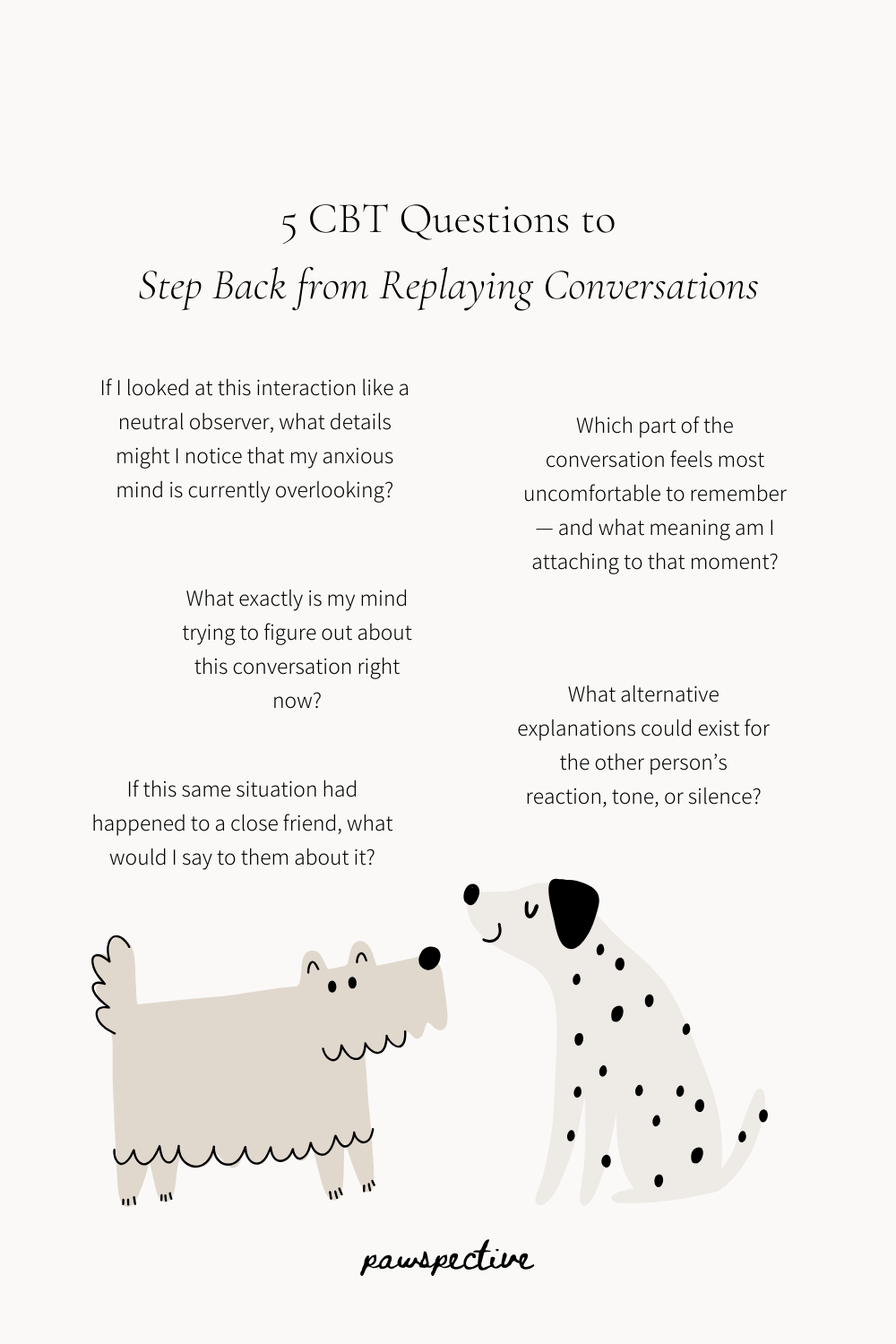
One strategy is to shift from reviewing the conversation to naming the process.
When you notice the replay beginning, pause and say to yourself:
“My mind is replaying this because something about it felt uncertain or uncomfortable.”
This may seem simple, but it can be psychologically powerful. Instead of jumping straight into the content of the thought, you first recognise the process. That creates a little distance. You are not immediately asking, What exactly did they mean? You are noticing, My mind is doing the replay thing again.
This works because it reduces fusion with the thought and helps you move into a more observing position. From there, ask yourself:
“Is there one useful thing to take from this, or am I stuck in rechecking?”
If there is one clear and practical takeaway, keep it small. Perhaps you want to clarify something tomorrow. Perhaps you want to speak more directly next time. If there is no useful action, that often means you are in rumination rather than reflection.
A very small step you can try now
Complete this sentence:
“What feels hardest about this conversation is not the conversation itself, but the uncertainty that…”
Even a brief answer can help you identify what the mind is really reacting to.
A guided structure can sometimes help
In therapy, I often use simple structured reflection exercises to help people step back from mental loops and look at their thoughts with a little more distance and kindness, rather than analysing every detail of the situation.
One tool I particularly like teaching is the “Anxiety Monster” exercise. Instead of treating anxious thoughts as facts, you give them a character. By naming or sketching the “monster”, many people find it easier to see these thoughts as something the mind produces — not something they have to believe or follow immediately. This small shift can create helpful distance from the spiral.
If you would like to explore this exercise yourself, you can find the tool here:
Anxiety Monster CBT Pad
Some people also prefer learning these skills through guided audio exercises, especially when thoughts feel overwhelming or difficult to organise. A short guided session can help you practise stepping back from anxious thinking, noticing thoughts without immediately following them, and allowing them to pass more gently.
If that approach feels more supportive for you, you may find an audio-guided practice for creating distance from thoughts helpful as well.
You can explore it here:
Calming Thoughts Practice Kit

Closing reflection
When conversations replay in your head, it does not automatically mean you did something wrong. More often, it means your mind has detected uncertainty and is trying to protect you in a way that is understandable, but not always helpful. Change usually begins not by forcing these thoughts away, but by recognising the pattern with a little more patience and a little more perspective. Over time, that shift can help the mind loosen its grip.
You might also find helpful



Safety note
This article is intended for educational purposes and does not replace professional mental health care. If you are experiencing significant distress or mental health difficulties, seeking support from a qualified professional can be an important step.
Sources & Further Reading
Beck, J. S. (2021). Cognitive behavior therapy: Basics and beyond (3rd ed.). Guilford Press.
Clark, D. A., & Beck, A. T. (2010). Cognitive therapy of anxiety disorders: Science and practice. Guilford Press.
Hayes, S. C., & Smith, S. (2005). Get out of your mind and into your life: The new acceptance and commitment therapy. New Harbinger.
Hayes, S. C., Strosahl, K. D., & Wilson, K. G. (2016). Acceptance and commitment therapy: The process and practice of mindful change (2nd ed.). Guilford Press.
Hirsch, C. R., & Mathews, A. (2012). A cognitive model of pathological worry. Behaviour Research and Therapy, 50(10), 636–646.
Nolen-Hoeksema, S., Wisco, B. E., & Lyubomirsky, S. (2008). Rethinking rumination. Perspectives on Psychological Science, 3(5), 400–424.
Watkins, E. R. (2008). Constructive and unconstructive repetitive thought. Psychological Bulletin, 134(2), 163–206.
Watkins, E. R. (2016). Rumination-focused cognitive-behavioral therapy for depression. Guilford Press.
