
Why Your Mind Won’t Switch Off at Night (And What Your Brain Is Trying to Do)

Many people notice that their mind becomes unusually active the moment they lie down to sleep. The day may have felt manageable, even calm, yet once the lights are off thoughts begin to gather. Conversations replay. Small worries suddenly feel larger. Plans for tomorrow start unfolding in detail.
In my work with clients, this moment is described in many ways. Some people speak about a “mental replay button” that keeps pressing itself. Others describe a mind that begins scanning for problems just when they hoped to finally rest.
Although this experience can feel frustrating, it is extremely common. In many ways, it reflects how the brain naturally processes unfinished experiences.
Understanding why this happens can make the experience feel far less confusing — and often easier to manage.
In this guide
In this article, you will learn:
why thoughts often become louder at night
• how the brain processes unfinished experiences during quiet moments
• why trying to force sleep can make the mind more active
• one small psychological strategy that can help calm nighttime overthinking

What this experience actually is
Night-time thinking often appears when external stimulation decreases.
During the day, our attention is usually occupied by conversations, work tasks, messages, and movement. These activities keep the brain focused outward.
When evening arrives, the environment becomes quieter. Fewer distractions are present, and the brain naturally shifts into a more reflective mode.
Many people I meet in practice describe noticing thoughts they barely had time to register earlier in the day. A comment from a colleague returns to mind. A task that still needs attention suddenly feels urgent. A conversation is replayed again and again.
This happens partly because the brain uses quiet moments to organise information from the day.
In psychology, this reflective state is often linked to the default mode network — a brain system that becomes more active when we are not focused on a specific external task. In this mode the mind naturally begins reviewing experiences, imagining future scenarios, and reflecting on social interactions.
For some people this process remains calm. For others it can develop into loops of worry, planning, or replaying events.
From a psychological perspective, the mind is not trying to disturb sleep. It is attempting to process unfinished thoughts.
For a broader understanding of this pattern, read Understanding Overthinking: Why the Mind Replays Thoughts.
If your mind also replays conversations, Why Conversations Replay in Your Head explores this in more depth.
Psychoeducation: What is happening psychologically
Several psychological processes tend to come together in the evening.
Reduced distraction
During the day attention is constantly directed outward. When stimulation decreases, internal thoughts become more noticeable.
Cognitive processing of unfinished concerns
The brain naturally tries to organise incomplete tasks or unresolved experiences. Psychologists sometimes refer to this as the Zeigarnik effect, which means unfinished matters remain mentally active until they feel resolved.
Emotional processing
Emotions that were pushed aside during the day may surface once the environment becomes quiet. The mind begins sorting through emotional experiences that had little space earlier.
Sleep performance pressure
A subtle but important factor is the pressure people place on themselves to fall asleep quickly.
Thoughts such as “I need to sleep now” or “I must not overthink” can unintentionally increase alertness.
The brain interprets pressure as a signal that something important is happening, which can increase mental activation instead of relaxation.

What many people misunderstand
A common belief is that the goal should be to completely stop thinking before sleep.
However, the human mind rarely becomes entirely silent. Trying to force thoughts away often makes them more persistent. In psychology this is known as thought suppression rebound.
A more helpful approach is learning to allow thoughts to settle naturally without engaging with every mental thread that appears.
Therapist perspective
In therapy I often notice that people interpret night-time thinking as a personal failure.
Many say things like:
“I should be able to switch off.”
“Other people probably fall asleep easily.”
Yet this pattern usually reflects something quite understandable.
During busy days many people operate in problem-solving mode. Concerns are postponed because there is no time to process them fully. By evening the brain finally has space to revisit unfinished thoughts.
When someone learns to approach these thoughts with curiosity rather than frustration, the experience often becomes less intense.
Instead of fighting the mind, the focus shifts toward gently guiding attention.
A practical strategy: Externalising the unfinished loop
One helpful approach is what I sometimes call “externalising the unfinished loop.”
If the brain is trying to organise thoughts, we can give it a place to store them.
A short reflection before bed can signal to the mind that important concerns have already been acknowledged and recorded.
How to try this
Step 1
Before going to bed, take two minutes to write down any thoughts that feel unfinished.
Step 2
Next to each thought, write one of two labels:
• Something I will handle tomorrow
• Something that does not require action right now
Step 3
Close the notebook and place it somewhere visible for the morning.
This process works because the brain no longer needs to keep holding the information in working memory.
A very small step you can try tonight
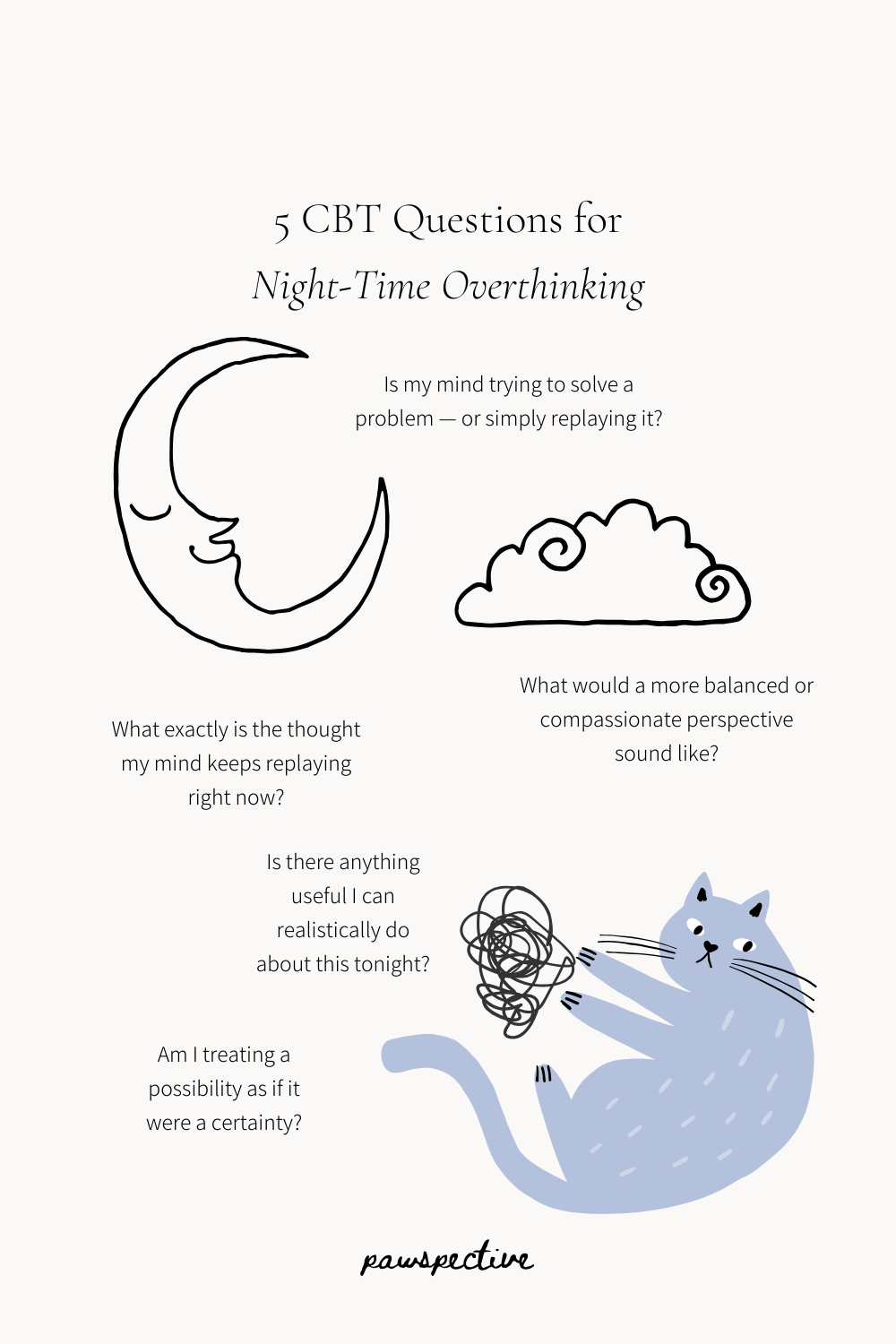
If your mind begins replaying thoughts in bed, try quietly telling yourself:
“I’ve noticed this thought. I can return to it tomorrow.”
Then gently bring your attention to something simple, such as your breathing or the sensation of the pillow beneath your head.
A guided structure can sometimes help
In my work with clients, exercises like this are often easier to practise with a clear structure. Writing thoughts down step by step helps many people slow the thinking process and begin to notice their thoughts with a little more distance.
Because this pattern appears so frequently in therapy sessions, I created the Calming Thoughts Practice Kit. It combines a short guided audio exercise with structured worksheets designed to help organise racing thoughts and practise stepping back from overthinking.
You can explore it here:
Calming Thoughts Practice Kit

Closing reflection
A mind that becomes active at night is often a mind that has been quietly carrying many things during the day.
Rather than seeing these thoughts as a problem to eliminate, it can be helpful to view them as signals that the brain is trying to organise experiences.
With gentle structure, patience, and curiosity, many people discover that their relationship with these thoughts gradually becomes calmer and more manageable.
Sleep rarely returns through force. It tends to emerge when the mind finally feels safe enough to settle.
You might also find helpful



Safety note
This article is intended for educational purposes and does not replace professional mental health care. If you are experiencing significant distress or mental health difficulties, seeking support from a qualified professional can be an important step.
Sources & Further Reading
Beck, J. S. (2020). Cognitive behavior therapy: Basics and beyond (3rd ed.). Guilford Press.
Harvey, A. G. (2002). A cognitive model of insomnia. Behaviour Research and Therapy, 40(8), 869–893.
Hayes, S. C., Strosahl, K. D., & Wilson, K. G. (2016). Acceptance and commitment therapy: The process and practice of mindful change (2nd ed.). Guilford Press.
Kross, E., & Ayduk, O. (2017). Self-distancing: Theory, research, and current directions. Advances in Experimental Social Psychology, 55, 81–136.
Morin, C. M., & Espie, C. A. (2004). Insomnia: A clinical guide to assessment and treatment. Springer.
Watkins, E. R. (2016). Rumination-focused cognitive-behavioral therapy for depression. Guilford Press.
Zeigarnik, B. (1927). On finished and unfinished tasks. Psychologische Forschung, 9, 1–85.
